Dry chlorine products filling machine: key points in 30 seconds
Technical summary:
Dry chlorinated products are corrosive powders, tablets, or granules that can be abrasive and often dusty. Their filling process creates significant constraints on material compatibility, dust management, and equipment durability.
The vertical auger filler is the most suitable solution for filling dry chlorine products. It ensures precise, clean and repeatable dosing, while limiting product loss and dust emissions.
The choice of machine and filling line then depends on the level of product exposure, safety constraints and selected materials. Our approach follows the MOM logic: characterize the product, choose the appropriate filling technology, and validate performance through real-condition testing with your product and final packaging.
Dry chlorine products: a wide range of types
Corrosive powders and granules
Dry chlorinated products mainly come in the form of powders, large tablets, or granules. Their corrosive, and sometimes abrasive, nature creates specific constraints for equipment and for all materials in contact with the product.
Specific product behaviors
Like other industrial powders, they can exhibit a wide range of behaviors depending on their composition: dustiness, poor flowability or sensitivity to humidity. These parameters directly impact dosing stability and filling cleanliness.
As a result, a chlorine powder can be both corrosive and dusty, combining multiple filling constraints.
What packaging is used for dry chlorine products?
Dry chlorine products are generally packaged in bags, buckets or industrial containers. The packaging format directly impacts the design of the filling line, particularly in terms of throughput, automation level and dosing tooling.
Design of filling lines for dry chlorine products
Materials adapted to corrosive products
Filling lines for these dry products must use suitable materials. Machinable plastics such as PVC, HDPE, PPHD or PEEK are commonly used. The use of untreated metals is highly restricted.
Material selection is critical to ensure the durability of the filling line.
Surface treatments and exposure level
First, in the case of aluminum, a surface treatment is required. However, epoxy coating on aluminum is not always effective. In practice, swelling and deterioration are often observed on epoxy-coated parts after several years of use — sometimes even sooner.
Then, for stainless steel, the choice depends on the level of exposure to the product: direct contact, proximity or distance. Not all stainless steel grades offer the same level of resistance. 316L stainless steel is more corrosion-resistant than 304L, but in some cases, a different grade or even a plastic material may be required.
In short, the level of exposure to chlorine determines the choice of material and treatment.
Considering fine particles
It is important not to consider only the parts in direct contact with chlorine. Fine particles can also cause damage to components located near the filling area, even without direct contact.
Component selection: seals and fasteners
The choice of peripheral components is also critical.
Regarding seals, material selection is important: in case of direct contact with chlorine, Viton is the most suitable.
Then, for fasteners, using PEEK components in splash-exposed areas provides better durability than stainless steel equivalents.
In conclusion, Viton is recommended for seals in contact with chlorine, and PEEK is more durable than stainless steel in splash-exposed areas.
Why the vertical auger is the right technology
Filling dry chlorine products requires combining dosing accuracy, safety and equipment durability.
The choice of technology depends on product behavior and corrosion constraints.
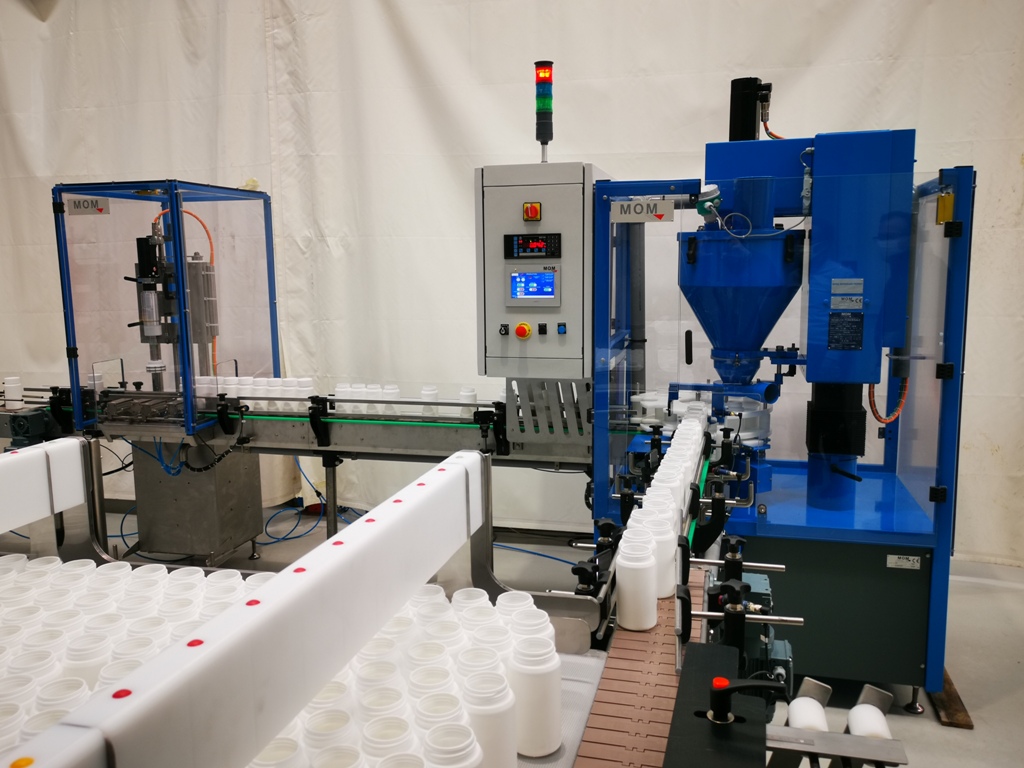
The vertical auger filler is particularly well suited for this type of product. It can handle dusty powders while maintaining good dosing consistency and limiting product losses.
It can operate in volumetric or gravimetric mode depending on the required accuracy.
Comparison of constraints and filling solutions
| Product constraint | Impact on filling | Technical solution |
|---|---|---|
| Corrosion | Equipment degradation | Suitable materials (PEEK, plastics, treated stainless steel) |
| Dustiness | Dust, product loss | Vertical auger, sealed design |
| Abrasion | Component wear | Material and treatment selection |
| Chemical exposure | Risk for seals and fasteners | Viton, PEEK fasteners |
This table summarizes the constraints described on this page and their direct impact on filling line design.
Product feeding
As with all powders, maintaining a constant level in the hopper is key to ensuring dosing accuracy. A constant level helps stabilize volumetric dosing.
Testing and validation of filling machines for dry chlorine products: what to check
Validation under real conditions is essential for this type of product. It allows verification of dosing accuracy, repeatability and filling cleanliness.
It also allows validation of equipment resistance to chemical constraints and the suitability of selected materials.
Thus, testing allows validation of both the process and the materials: request to participate in tests with your dry chlorine products in your packaging.
MOM Packaging has manufactured filling machines for dry chlorine products for many customers.
Since 1927, MOM Packaging has been designing dosing and filling machines, with strong expertise in powder packaging.
To bear in mind
Dry chlorine products involve significant constraints due to their corrosive, abrasive and dusty nature. Their filling requires a comprehensive approach combining dosing technology and line design.
The vertical auger is the most suitable solution for this type of product. Material selection is a key success factor. Validation under real conditions remains essential to secure each application.

Louis Derangère
CEO of MOM Packaging — Industrial automation engineer and precision dosing expert.