
Dietary supplement filling machine: the key points in 30 seconds
Technical summary:
Dietary supplements come in different dry forms: powders, microgranules, seeds, capsules or tablets. Each format involves specific constraints in terms of dosing and filling.
For products in powder or microgranule form, the vertical auger filling machine is the most suitable solution. For capsules and tablets, however, two approaches are possible: a counter for unit-based dosing, or a gravimetric filling machine when weight accuracy is required.
In this article, we summarize the most common questions from our clients looking to equip themselves with a dietary supplement filling machine. You will discover best practices for choosing the right dosing technology, controlling product feeding and selecting the appropriate tooling.
Our approach is based on MOM’s logic: characterize the product, choose the right filling technology, then validate performance through trials under real conditions, with the product and its final packaging.
Dietary supplements: a wide range of product types
Powders, microgranules, seeds, capsules, tablets
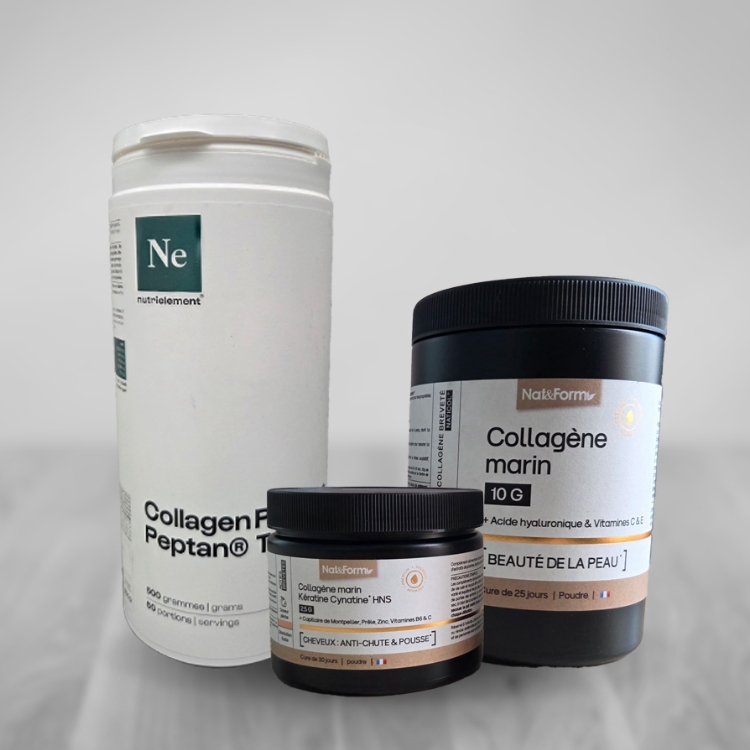
Dietary supplements come in a wide variety of forms. These include powdered products such as protein, collagen, creatine, maca or spirulina. Some supplements can also be offered in microgranule form, such as spirulina. Others are available as capsules or tablets. Lastly, some ingredients such as flax can be sold whole, for example as seeds to be ground before use, or already ground (as a powder). The physical form of the product has a direct impact on filling behavior and on the choice of technology.
The same product family, but very different behaviors
Even when they belong to the same commercial category, two dietary supplements can behave very differently during dosing. These differences may come from bulk density, particle size, flowability, dustiness, stickiness, sensitivity to humidity, or a tendency to cake. A powder may be free-flowing, prone to caking, dusty, electrostatic or hygroscopic, and these properties directly guide the choice of technology and tooling. A very concrete example: you may find collagen powder that is highly dusty, with a density of 0.38, and sticky, caking maca with a density of 0.61.
Single supplements vs formulated blends
Some dietary supplements are packaged on their own, while others are formulated as more complex blends. A protein powder may, for example, be combined with flavors, vitamins, sweeteners or other ingredients. Even a small change in the formulation can alter the product’s behavior during filling. A blend may become stickier, dustier, less stable, or more sensitive to flow variations.
What packaging formats are used for dietary supplements?
Dietary supplements in jars
Many dietary supplements are packaged in jars, especially powders and microgranules. This is a common format for protein, collagen, creatine, spirulina or maca. Doses can vary significantly depending on the product, the marketing promise and the intended use. Some jars may also build up static electricity before filling, which can affect the cleanliness of the dosing area and require appropriate treatment before filling.
Dietary supplements in pouches
Pouches are also common for powders and dry products. Flat-bottom pouches are frequently used, along with other formats depending on the target market. One key challenge is preventing product from entering the sealing area. The dosing tooling must therefore be designed to enter the package during filling in order to maintain a clean fill.
Dietary supplements in bags or large formats
Some dietary supplements or base ingredients may also be packaged in large formats, especially for B2B uses, professional distribution channels or intermediate stages. The approach then depends on the dose, the level of automation, the required accuracy and the organization of the line.
Capsules and tablets
Capsules and tablets follow a different logic. Here, the goal is no longer to dose a free-flowing powder but to count units. In practice, tablets are often handled upstream by a tablet press and then by a counter during packaging. Capsules are also often handled by a counter (vibratory chute), or in some cases by a dosing solution adapted to their presentation format. A counter counts units, whereas a vertical auger filler doses until a target weight is reached. This distinction is essential to properly define a project.
Which filling machine should you choose for dietary supplements?
Goal: clean and accurate dosing
For dietary supplements in powder or microgranule form, the objective remains to achieve precise, repeatable, and clean dosing. A vibratory feeder may generate a significant amount of fines when handling dusty powders. Horizontal dosing is mainly used for process applications or large-volume filling, such as bulk bags, which do not require the same level of precision and cleanliness as packaging ranging from a few grams to several tens of kilograms. A vertical auger dosing system accurately handles both powders and microgranules. This is why, in most cases, it remains the preferred technology for packaging dietary supplements in powder or microgranule form, as well as certain similar dry products such as seeds or ground ingredients.
Why the vertical auger is often the right technology
The vertical auger is especially relevant for this product family because it can handle a wide variety of dry dietary supplements using a true dosing logic by weight or volume, rather than counting. It is therefore suitable for powders such as protein, collagen, creatine, maca or spirulina, but also for other dry products when the goal is to dose a given mass of product rather than count units. By contrast, when dealing with capsules or tablets, a counter is generally more suitable precisely because it counts units.
Comparison of filling technologies
| Product type | Optimal technology | Type of dosing | Possible technology | Advantages |
|---|---|---|---|---|
| Powder | Vertical auger | By weight or volume | Vertical auger | Accuracy, cleanliness, versatility |
| Capsules, tablets | Counter | By count | Vertical auger | Fast, simple, reliable |
How to feed the product
Maintaining a constant product level in the hopper helps maximize dosing accuracy. Product feeding then depends on the layout of the workshop. If the product arrives at the same level as the filler, pneumatic transfer can be effective. If the product arrives from an upper floor, gravity feeding may be preferred.
Dietary supplement filler trials and validation: what you need to check
To secure a dietary supplement filling project, the most reliable approach remains validation under real conditions: ask to take part in tests with your dietary supplements in your packaging.
These tests make it possible to verify:
- dosing accuracy
- repeatability
- throughput
- fill cleanliness
- the level of dust or fines
- the simplicity and speed of disassembly for cleaning
- the number of dosing tools required for all your products
In more demanding environments, especially for projects related to the pharmaceutical industry or carried out in a controlled environment, the requirements to request are IQ/OQ/PQ qualifications and traceability of contact materials.
MOM Packaging supports manufacturers in more than 60 countries across Europe, Africa, the Middle East, Oceania, the Americas and East Asia.
Key takeaways
- The vertical auger is suitable for dietary supplements in powder, microgranule and grain form.
- The counter is used for dietary supplements in capsule form.
- Volumetric or gravimetric technology depends on throughput and accuracy targets.

Louis Derangère
CEO of MOM Packaging — Industrial automation engineer and precision dosing expert.