Collagen filling machine: the essentials in 30 seconds
Technical summary:
Collagen is now in high demand across several markets, food, cosmetics, and pharmaceuticals. Important fact : collagen powder is often dusty (powdery) and can be electrostatic. Vertical auger filling machines are ideal for precise collagen powder dosing, ensuring high accuracy while minimizing fines generation.
When investing in an industrial collagen powder filling machine, the key questions are: how do you achieve consistent dosing, control dust, and secure the project when the product changes from one supplier to another?
This article reviews the constraints to consider before investing in an industrial collagen powder filling machine, and the best practices for choosing the dosing technology, product feeding, and tooling.
What constraints apply to a collagen filling machine?
Product variability: why two collagen powders do not fill the same way
Collagen powder is made of collagen peptides. Depending on the manufacturing process, noticeable variations can be observed from one powder to another.
In practice, on the samples analyzed, bulk density ranges from 0.40 to 0.60. This data, together with flow behavior, directly impacts dosing sizing and tooling.
The behavior of a collagen powder can also change depending on its origin (e.g., marine vs bovine collagen) and the manufacturing process.
Therefore, it is important to warn readers: knowing the extreme characteristics makes it possible to handle all collagen varieties.
Flowability: a fairly free-flowing powder… but not always
In certain observed collagen formulations, the powder is described as fairly free-flowing, fairly pourable, slightly sticky, and with very low caking tendency.
This is why these characteristics are critical for dosing tool design: they allow dosing with precision, cleanliness (no fines), and at high throughput.
Static electrcity: a point not to underestimate
Collagen powder may be electrostatic. An electrostatic powder adheres more easily to packaging surfaces. As a result, it can dirty them and disrupt dosing consistency.
Therefore, for clean dosing, this must be considered during tooling design and confirmed during real-condition trials.
Dustiness: how to manage fines in a collagen powder filling machine?
Collagen powder can be dusty (and sometimes VERY dusty). A dusty powder generates fines; in this case, the main risk is contamination of sealing areas and build-up (fouling).
However, this issue is not unsolvable. Technically advanced machine builders act on the cleanliness of the filling environment, especially around transfer, dosing, and packaging closing zones.
It is necessary to keep the process stable and limit the impact of fines on production.
Blends: when collagen powder can become sticky
Collagen powder is often blended with other ingredients (vitamin E, hyaluronic acid, etc.). The purpose is to specialize the collagen, for example for joints, skin beauty, etc.
Indeed, these additions can modify powder behavior and make it more sticky.
Again, product characterization is essential to secure equipment selection and define tooling suitable for all your collagens.
What dosing solution for a collagen filling machine?
What guides the choice
For supplement powders, the key objectives are repeatability (achieving the same dose consistently over time), cleanliness, and throughput.
The choice of dosing technology must take into account:
-
powder behavior (bulk density, flowability, electrostatic effects, dustiness)
-
whether blends are present
-
cleaning requirements / production organization (food, cosmetics, pharma)
-
packaging formats and required speeds
Key point: tooling can make the difference
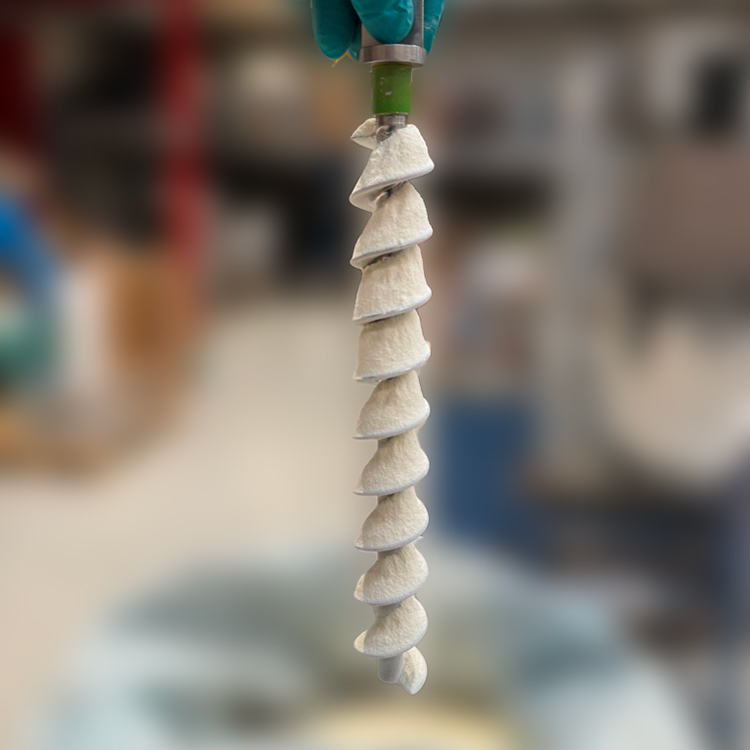
Even with an appropriate dosing technology, tooling is critical: the design of the screw / dosing element depends on the product’s characteristics.
If you have several producers or several collagen types, you may need different dosing tooling depending on the powders to maintain consistent filling.
| Decision | Main risk | What to check first |
|---|---|---|
| Bovine collagen vs marine collagen | behavior variations | 1 or 2 dosing tools needed (easy disassembly) |
| Powder alone vs blended powder | more sticky powder | 1 or 2 dosing tools needed (easy disassembly) |
| Electrostatic powder | less stable flow, adhesion | dosing cleanliness |
| Dusty powder | fines / dust | dosing cleanliness |
Product feeding and cleaning: securing production for all markets
Product feeding: do not generate fines
Choosing dosing technology is not enough. In addition, you must define how the dry-product filling machine is fed with powder, to avoid generating upstream dust.
A feed flow synchronized with the machine will help maintain a constant level in the doser and further optimize accuracy.
Cleaning an industrial collagen powder filling machine: key checkpoints
Before choosing an industrial collagen powder filling machine, make sure to check:
-
Are the product-contact parts easy to disassemble?
-
Does disassembly allow cleaning quality suitable for your market?
-
Does the design limit areas where powder can accumulate (fine / electrostatic powder)?
-
How simple and fast is disassembly (direct impact on downtime)?
Attend production trials for industrial collagen powder filling machines
To secure a collagen project, the most reliable approach is validation in real conditions: request to attend production trials.
In summary, these tests allow you to check:
-
dosing accuracy
-
consistency (across consecutive containers)
-
throughput
-
whether electrostatic effects impact performance
-
dust/fines level and zone cleanliness
-
simplicity and speed of disassembly for cleaning
-
dosing robustness across different collagen types (e.g., marine vs bovine) or different suppliers
In recent years, MOM Packaging has supplied collagen powder filling machines every year.
Since 1927, MOM Packaging has designed dosing and filling machines with longstanding expertise in powders and dry products.
For a broader technical overview of powder behavior, dosing technologies, and industrial validation methods, read our Complete Guide to Industrial Powder Filling.