Bicarbonate filling machine: key points in 30 seconds
Technical summary:
Bicarbonate is a high-demand product. When selecting a bicarbonate filling machine, three main factors must be considered: fine particle management, variability in product granulometry, and the choice of materials in contact with the product. Some bicarbonates are dusty, requiring effective dust control during filling. Others may behave either as powders or as microgranules depending on the supplier or even the batch.
For this application, it is preferable to use vertical auger dosing rather than a vibrating feeder. Vibrating feeders tend to generate dust, whereas vertical auger dosing effectively manages this issue.
Powdered bicarbonate: a wide range of types
Powder or microgranules depending on the case
The particle size of bicarbonate can vary depending on the supplier. It can also happen that the same supplier does not fully control the granulometry of the bicarbonate delivered. It is therefore necessary to use a versatile machine capable of dosing both bicarbonate behaving like a powder and bicarbonate behaving like microgranules.
Fine particle management
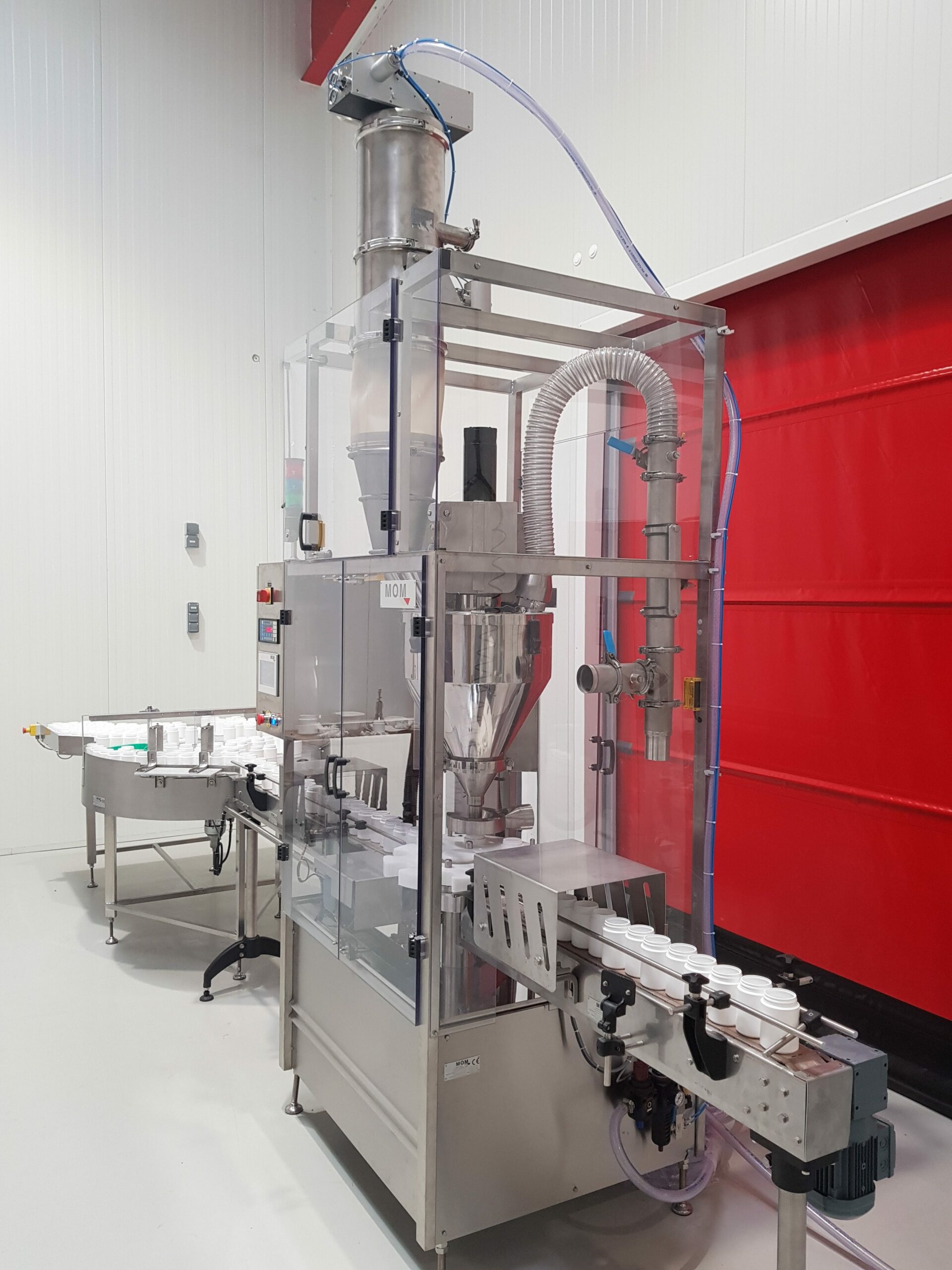
Some bicarbonates are dusty. During filling, to avoid generating dust, a filling machine equipped with suction nozzles connected to your extraction system is required. If no extraction system is available, it is recommended to integrate a suitable solution directly.
What packaging is used for bicarbonate?
Bicarbonate can be packaged in various formats depending on usage and market requirements. The dosing range can be very wide, for example from 50 g to 7 kg on the same machine. The choice of the machine will therefore depend on the level of automation, the target production rate and the packaging format.
Why the vertical auger is often the right technology for bicarbonate filling
Bicarbonate can be dusty and generate fine particles. In this context, vertical auger dosing helps limit these effects while ensuring precise and consistent dosing. In contrast, vibrating feeders tend to generate more dust and are less suitable for this type of product.
The variability in bicarbonate granulometry requires a machine capable of adapting. It must be able to handle both powders and microgranules without loss of accuracy or production speed.
Materials to choose for a bicarbonate filling machine
Bicarbonate does not present a risk of ignition and does not require materials specifically resistant to corrosion.
For parts in contact with the product, the use of 316L stainless steel is recommended. This material ensures both food-grade compliance and long-term durability.
Comparison of constraints and filling solutions
| Product constraint | Impact on filling | Technical solution |
|---|---|---|
| Dusty bicarbonate | Dust generation | Suction nozzles + vertical auger dosing |
| Product contact parts | Need for durability and food compliance | 316L stainless steel |
| Production rate and automation | Machine configuration selection | High-speed, monoblock, linear or semi-automatic |
Product feeding
For bicarbonate, managing fine particles is essential. It is recommended to use a machine equipped with suction nozzles connected to an extraction system in order to limit dust emissions during filling.
Testing and validation of bicarbonate filling machines: what to check
To secure your powdered bicarbonate filling project, the most reliable approach is validation under real conditions: request to participate in tests with your bicarbonate and packaging.
It is important to check several points:
- the machine’s ability to manage dust with dusty products
- versatility between powder and microgranule dosing
- the choice of technology (vertical auger vs vibrating feeder)
- the suitability of materials in contact with the product
- compatibility with the required production rate and automation level
MOM Packaging has manufactured filling machines for powdered bicarbonate for many customers.
Since 1927, MOM Packaging has been designing dosing and filling machines, with strong expertise in powder and dry product processing.
Key takeaways
Bicarbonate is a high-demand product, but its filling requires careful consideration of several constraints. Managing fine particles is essential to ensure a clean production environment. Variability in granulometry requires a versatile machine capable of handling both powders and microgranules.
In this context, vertical auger dosing is the most suitable solution. The choice of materials, particularly the use of 316L stainless steel for product-contact parts, also contributes to the reliability and durability of the line.

Louis Derangère
CEO of MOM Packaging — Industrial automation engineer and expert in precision dosing.