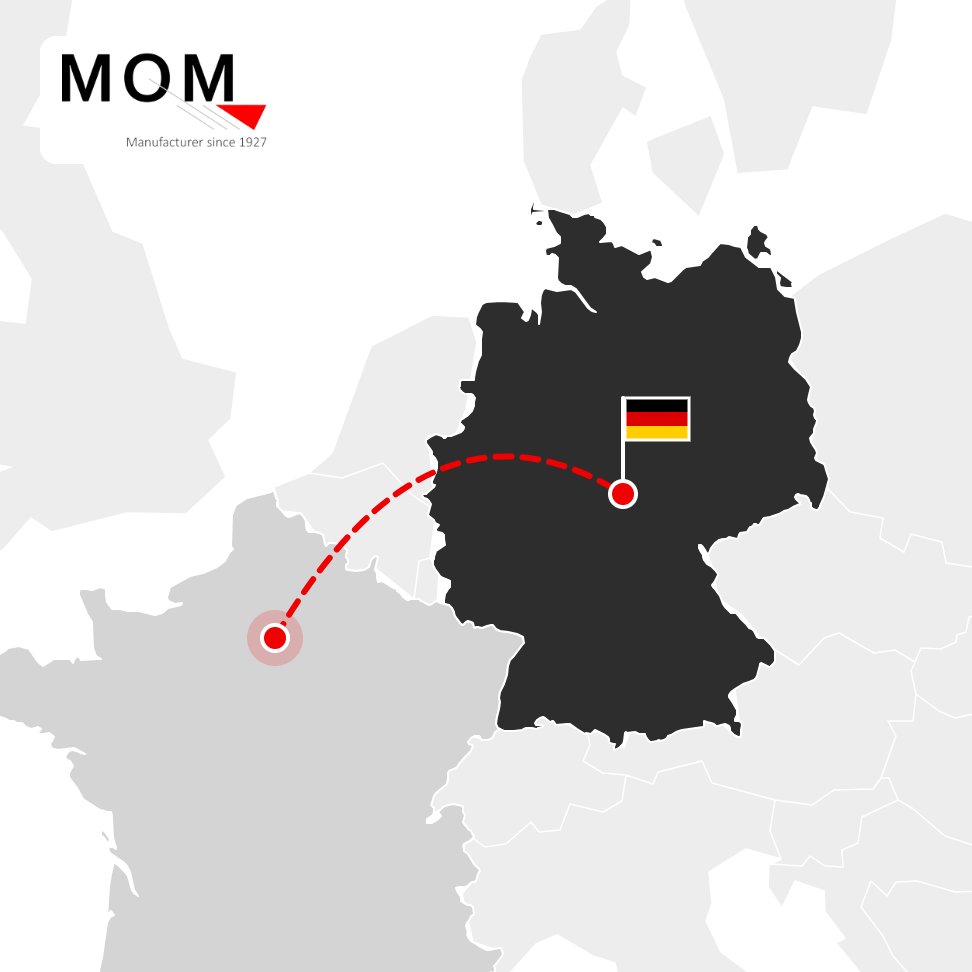
MOM Packaging installed a medicinal powder dosing line at a German pharmaceutical manufacturer. Doses of 10 to 20 g, a rate of 120 to 150 cycles per minute, under European GMP requirements.
A project on the German pharmaceutical market
Germany is the leading pharmaceutical market in Europe. Manufacturers there apply very strict requirements. Equipment qualification, technical documentation, production traceability: every step is regulated.
It is in this context that MOM Packaging stepped in. The project involved a high-speed medicinal powder dosing line. An installation representative of what the French manufacturer delivers in more than 60 countries.
The challenge: combining high speed and pharmaceutical precision
Dosing medicinal powders calls for strict tolerances. They are far tighter than in food or chemical applications. In return, the rate usually stays moderate in this sector. Precision takes priority over throughput.
This project combined both requirements. At 120-150 cycles per minute, each cycle lasts less than half a second. On doses of 10 to 20 g, the margin is very small. The flow must be stabilised, filled, checked, and the pack released.
Three parameters then become critical.
Consistent product feeding
At high speed, the hopper empties quickly. Yet the height of powder influences the apparent density at the screw. Without level regulation or suitable agitation, the dose drifts. Product feeding must therefore keep conditions constant at the dosing inlet.
Mechanical repeatability of the dosing system
A machine running at 150 cycles per minute exceeds 70,000 cycles per production day. The slightest drift immediately translates into a dose deviation. A developing play, a tooling wear: the impact is direct. Design rigidity and machining quality become decisive.
In-line control and trend correction
At this rate, a checkweigher at the end of the line is no longer enough. By the time the deviation is detected, dozens of units have already been produced. The solution relies on a trend feedback system. A connected checkweigher sends deviations to the dosing system in real time. The system automatically adjusts its setpoint. Correction becomes continuous rather than curative.
Meeting European regulatory requirements
A pharmaceutical project is won as much on documentation as on the machine. The requirements are common to the whole European Union. Their level of application varies by market and by client.
- DQ, IQ, OQ and PQ qualifications: design, installation, operation and performance are covered by formal protocols.
- Data integrity and 21 CFR Part 11: electronic records and signatures are regulated. Access and changes are tracked.
- Production traceability: dosing data is recorded batch by batch, sometimes pack by pack.
- Cross-contamination prevention: design without retention zones and validated cleaning protocols.
- Technical documentation: CE marking and compliance with the Machinery Regulation (EU) 2023/1230.
These requirements are not added to the project. They structure it. They must therefore be built into the specifications from the start.
Why this type of project cannot be validated on paper
A medicinal powder has no standard behaviour. Particle size, apparent density, cohesion, residual moisture: everything varies. These parameters depend on the formulation and the upstream process. They sometimes change from one batch to the next.
No theoretical calculation guarantees speed and precision at the same time. The powder has to be seen flowing through the machine. MOM therefore systematically runs trials on the real product. These trials take place in the MOM workshop, in France, with the client’s teams.
MOM Packaging around the world
MOM Packaging supports manufacturers in more than 60 countries. Europe, Africa, the Middle East, Oceania, the Americas, East Asia.
Since 1927, the manufacturer has designed and built its machines in France, in Villepinte. It then installs them at its clients’ sites across the world. Each piece of equipment is delivered with documentation compliant with the country of installation. After-sales service relies on remote maintenance. In the vast majority of cases, the intervention is carried out remotely.
What this project shows
High speed and pharmaceutical precision are not necessarily at odds. They do, however, require a coherent overall design. Regulated feeding, rigid mechanics, in-line control with trend correction, complete documentation: every element counts.
This case also shows MOM’s ability to run demanding projects outside France. Experience gained across more than 60 countries, from Europe to East Asia.
Do you have a similar project?
IQ/OQ/DQ/PQ qualifications, 21 CFR Part 11 compliance, cleanroom and legal metrology are available across the MOM range. See the detail of these specific requirements.
MOM runs trials on your powders and packaging formats before any order. The aim: to validate the technology, the precision and the speed under real conditions.
Let’s talk about your specifications and your production constraints.
Discover also our high-speed filling machines, our complete guide to industrial powder filling and our article on the vertical screw doser.