
Vertical auger or vibratory feeder: the essentials in 30 seconds
Technical summary
To fill a powder, the first step is to understand the product’s real behavior. Bulk density, particle size distribution, dustiness, humidity, and caking tendency directly influence the choice of technology.
The vibratory feeder is simple, but it generates dust, slows down dosing, and is poorly suited to heterogeneous powders. The vertical auger requires better product knowledge, but it delivers greater accuracy, higher production rates, and cleaner dosing.
Why compare the vertical auger and the vibratory feeder?
The choice between a vertical auger and a vibratory feeder is not only about the filling machine. It also determines the level of accuracy, line cleanliness, and the ability to handle different powders.
To choose the right solution, several criteria must be considered together:
- powder behavior
- the dose to be filled
- the target production rate
- the expected accuracy level
- the production environment
- the type of packaging
How does a vibratory feeder work for powder filling?
The vibratory feeder moves the powder forward using a vibrating trough. This solution has the advantage of being simple and cost-effective: the number of dosing tools is limited. However, it lifts the product by vibration during dosing. This movement generates dust and makes fines harder to control.
With the same number of heads, the process can also be slower than other technologies. It works well with pieces or solid items. It becomes less reliable with powders, especially heterogeneous powders, because vibration separates the components. The vibratory feeder works only in gravimetric dosing. Manufacturers have largely limited the production of volumetric vibratory feeders for powder dosing because of their lack of accuracy.
This technology is better suited to rigid or less fragile products. It can also be used for unit-counting applications, such as certain candies, screws, nails, capsules, or tablets.
How does a vertical auger work for powder filling?
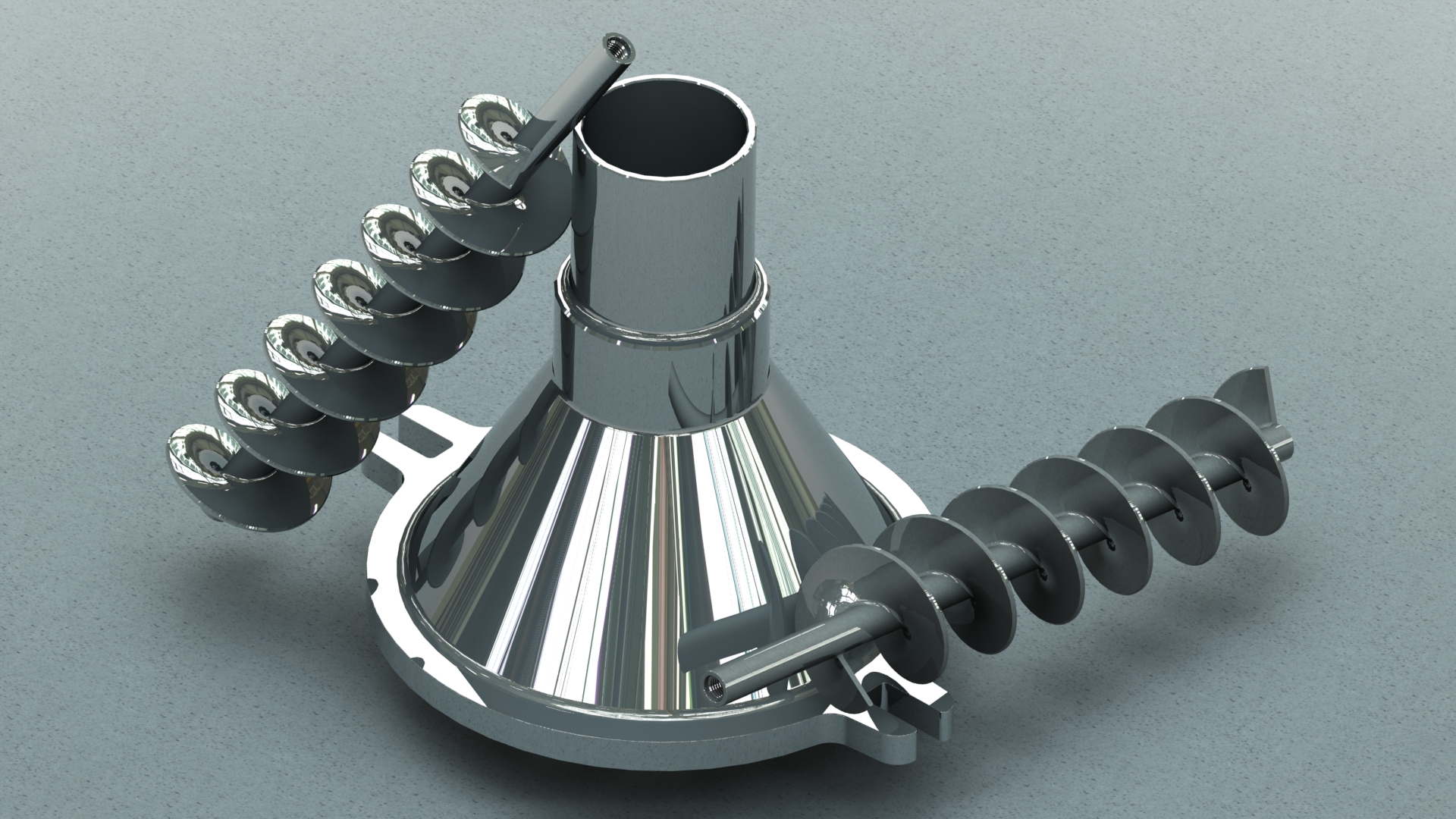
The vertical auger uses an Archimedes screw placed inside a funnel. The screw drives the powder toward the packaging with a more controlled flow.
This technology can operate in volumetric or gravimetric mode. It therefore adapts to different objectives depending on the dose, the target accuracy, and the product behavior.
The vertical auger is suitable for a wide range of powders. It allows better dust control, including with dusty powders such as protein powder, collagen, or chicory. It can also handle homogeneous, heterogeneous, fragile, sticky, hygroscopic, or caking powders.
What is the difference between a vertical auger and a vibratory feeder for powder filling?
1. Dosing cleanliness
The vibratory feeder lifts the powder. It therefore generates fines and dust more easily. This degrades the cleanliness of the filling area. Dust extraction systems used to limit fines can generate product losses that may become a blocking issue with dusty powders.
The vertical auger channels the product more effectively. It enables cleaner dosing. This advantage becomes essential when the objective is to reduce losses, preserve a sealing area, or maintain a cleaner environment.
2. Accuracy
The vibratory feeder offers less consistency with complex powders. It quickly reaches its limits when a fine and repeatable dose is required.
The vertical auger provides better accuracy control, depending on its geometry and the product properties. In volumetric mode, it is often well suited to doses below 1 kg, provided that a constant level is maintained in the hopper. In gravimetric mode, it can reach the accuracy of the scale division.
3. Production rate
For powders, the vibratory feeder remains relatively slow with a single head. To reach medium or high production rates, additional feeders must be added.
The vertical auger more easily combines speed and accuracy. It better meets projects requiring sustained production without compromising dosing quality. In practice, one vertical auger dosing head can reach 150 cpm with an agglomerating powder, whereas 4 vibratory feeders would be required for the same project.
4. Product integrity
For hard solid products, the vibratory feeder is effective despite the tapping effect. However, this agitation can degrade certain powders, generate more fines, or increase caking depending on the case.
The vertical auger is gentler on the product during dosing. It offers a better compromise between accuracy, speed, and material preservation. Large pieces, for example over 20 mm, are more difficult to dose with a vertical auger.
5. Heterogeneous powders
The vibratory feeder is poorly suited to heterogeneous powders. Vibration can separate the components and make filling more random.
The vertical auger better controls product transfer into the packaging. It reduces segregation effects.
Why does the vertical auger require more product knowledge?
The vertical auger does not work as a universal dosing system. To dose properly, you need a good understanding of the product’s flow behavior.
Several parameters influence tooling selection:
- bulk density
- density variability
- particle size distribution
- dustiness
- hygroscopicity
- the physical and chemical characteristics of the powder
The production environment also plays a major role. A moisture-sensitive powder does not behave the same way depending on the workshop atmosphere. At 60% humidity, the bulk density of a powder may vary, for example, from 0.48 to 0.6. This variation changes product flow, filling speed, and achievable accuracy.
Before finalizing the tooling, the powder must therefore be characterized under its real operating conditions.
When can a vibratory feeder still be relevant?
It can be relevant when the project is closer to counting than powder dosing, for example for capsules or tablets.
When is the vertical auger the best choice?
The vertical auger often becomes the best choice when a powder needs to be filled in a way that is:
- clean
- accurate
- repeatable
- fast
- controlled
It is particularly suitable for powders that are:
- dusty
- sticky
- hygroscopic
- caking
- heterogeneous
- fragile
- microgranular
It is also the preferred option when the project requires a high level of speed, accuracy, and cleanability.
Vertical auger vs vibratory feeder: quick comparison
| Criteria | Vertical auger | Vibratory feeder |
|---|---|---|
| Principle | Drives the powder using an Archimedes screw | Vibrates a trough containing the powder |
| Dosing type | Volumetric or gravimetric | Gravimetric only |
| Dust / fines | Better controlled | Generates more dust |
| Heterogeneous powders | Suitable | Risk of component separation |
| Production rate | More favorable | Relatively slow |
| Accuracy | Good control depending on configuration | More limited on complex powders |
| Product integrity | Better control | Can degrade certain products |
Why are trials still essential?
Even with a strong initial orientation, the choice should not be made without testing. Trials make it possible to verify:
- accuracy
- repeatability
- production rate
- dosing cleanliness
- the actual behavior of the powder
- ease of cleaning
- the fit between the powder, the packaging, and the tooling
Trials on a powder filling machine also validate the product behavior in its real environment. Ask to take part in trials with your product and packaging.
Conclusion
To fill a powder, it is not enough to simply compare the vertical auger and the vibratory feeder. The starting point must always be the real product and its constraints.
The vibratory feeder can be suitable for more rigid products. However, it quickly shows its limits with fine, heterogeneous, or sensitive powders.
The vertical auger requires more product expertise and more precision when selecting the tooling. In return, it offers a more robust solution for achieving clean, accurate, and industrializable dosing.
MOM Packaging supports manufacturers in more than 60 countries across Europe, Africa, the Middle East, Oceania, the Americas and East Asia.

Louis Derangère
CEO of MOM Packaging — Industrial automation engineer and precision dosing expert.