
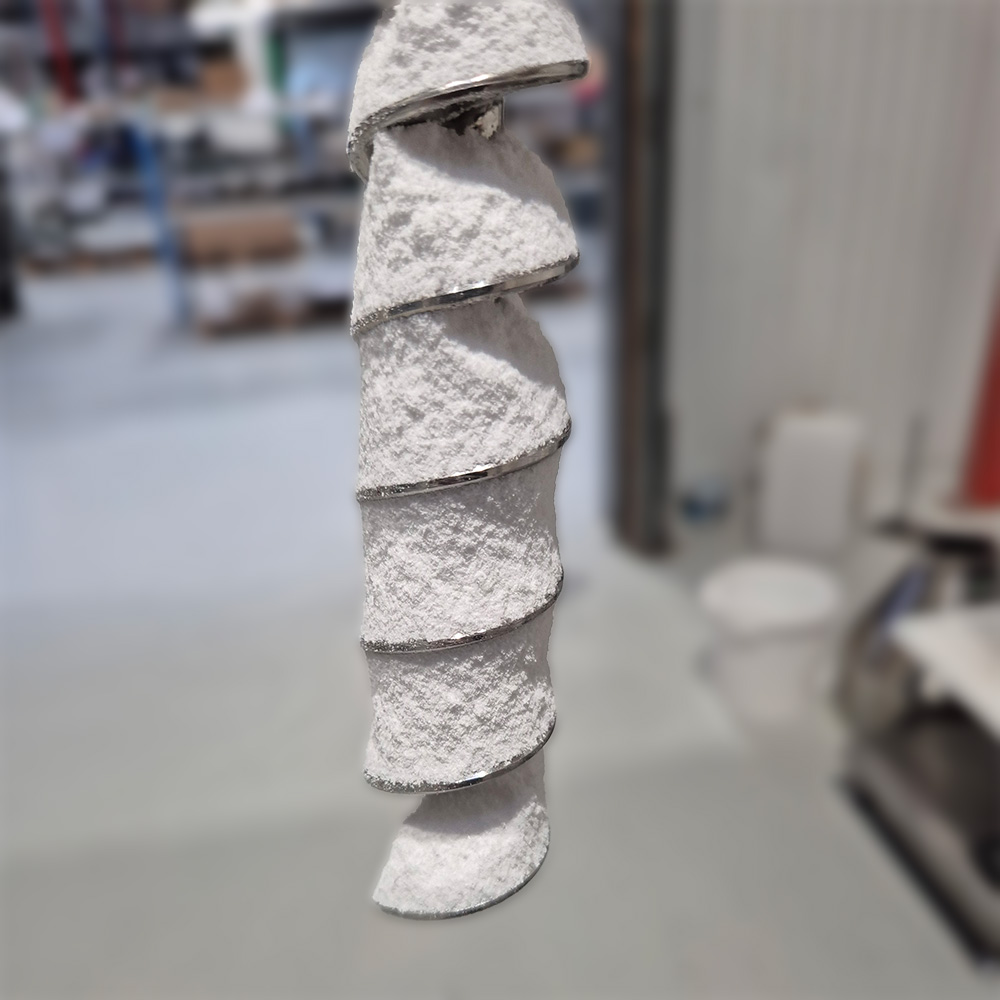
Creatine Filling Machine: The Essentials in 30 Seconds
Technical Summary
Creatine is available in several forms: powder, capsules, tablets, and gummies. However, the most common format today remains powder, particularly creatine monohydrate, which is widely used in the sports nutrition industry.
The choice of a creatine filling machine depends directly on the product’s physical form. For powders, a vertical auger filler is generally the most suitable technology. In contrast, capsules, tablets, and other unit-based formats typically require a counting machine, capable of accurately counting individual units.
As with all dietary supplements, the MOM approach starts by characterizing the actual behavior of the product, then selecting the appropriate filling technology before validating performance through real production trials.
Various creatine Formats
Creatine Powder: the most common format
Creatine powder remains the most widely recognized format on the market today. It is extensively used in the sports nutrition industry, especially for products designed for athletes seeking a rapidly available energy source during short, intense efforts.
Like many industrial powders, creatine can behave differently depending on its formulation, particle size distribution, bulk density, level of dustiness, or sensitivity to humidity. Some powders flow very easily, while others become more cohesive or more sensitive to caking.
Although powder remains the dominant format, creatine is now available in many different presentations.
On the market, creatine is primarily found as creatine monohydrate, sometimes in micronized form (capsules), as capsules, tablets, effervescent or non-effervescent, as well as gummies.
However, these formats follow a different industrial logic. Here, the objective is no longer to dose a free-flowing powder but to count individual units.
In this context, capsules, tablets, and gummies are generally handled using a counting machine, often fed by a vibrating system. This distinction is essential: a vertical auger filler doses a mass of product, whereas a counting machine counts a precise number of units.
This variability directly influences the choice of filling technology and machine settings, as explained in our technical powder filling glossary.
Pure creatine or formulated blends: sometimes very different behaviors
Not all creatine products behave the same way during industrial filling.
Indeed, some dietary supplements do not contain creatine alone. Depending on the manufacturer, formulations may be enriched with vitamins, minerals, proteins, taurine, flavorings, or sweeteners.
However, even a small formulation change can significantly alter product behavior during filling. A powder may become dustier, stickier, or less consistent in flowability.
In other words, two commercial creatine products may require different machine settings or tooling, even if they appear commercially similar.
In addition, some manufacturers highlight recognized quality labels such as Creapure®, a creatine monohydrate produced with a high level of purity and traceability. From a filling perspective, however, it is primarily the physical characteristics of the product that determine the most suitable technical solution.
Which filling machine for creatine?
Objective: clean and accurate filling
For powdered creatine, the objective is to achieve filling that is accurate, repeatable, and clean.
However, some technologies have limitations. For example, a vibratory feeder may generate more fines when handling dusty powders. Meanwhile, horizontal dosing systems are generally better suited to high-throughput or process applications.
In most cases, the vertical auger filler remains the most suitable technology for filling powdered creatine.
Why the vertical auger is often the right technology
The vertical auger offers particular advantages for this family of products, as it enables highly accurate dosing while maintaining a strong level of cleanliness.
It is especially suitable for the small doses commonly found in sports nutrition and can handle both simple powders and more complex formulations.
On the other hand, when dealing with capsules, tablets, or other unit-based formats, a counting machine generally becomes the more relevant option, precisely because it counts units rather than dosing a target weight.
Filling technology comparison
| Product Type | Optimal Technology | Dosing Type | Main Advantage |
|---|---|---|---|
| Creatine powder | Vertical auger | By weight or volume | Accuracy and cleanliness |
| Micronized creatine, capsules, tablets, gummies | Counting machine | By unit count | Speed and simplicity |
How should creatine be fed into the machine?
As with many powders, maintaining a constant product level in the hopper helps stabilize dosing performance and maximize accuracy.
The product feeding method then depends on the plant layout. When the product arrives at the same level as the filling machine, a pneumatic conveying system may be suitable. Conversely, a gravity-fed system may be preferred when the product comes from an upper floor.
Creatine filling trials and validation: what should you check?
To secure a creatine filling project, the most reliable approach remains validation under real production conditions.
Trials make it possible to assess dosing accuracy, repeatability, line speed, as well as filling cleanliness and the level of dust or fines generated.
They also help evaluate ease of disassembly for cleaning and determine the number of tooling configurations actually required to cover all product references.
In more demanding environments, especially projects close to the pharmaceutical industry or carried out in controlled environments, IQ/OQ/PQ qualifications and traceability of product-contact materials may also become key requirements.
For this reason, run filling trials using your own creatine product in your final packaging.
MOM Packaging supports manufacturers in more than 60 countries across Europe, Africa, the Middle East, Oceania, the Americas and East Asia.
Key Takeaways
- The vertical auger generally remains the best technology for powdered creatine.
- Capsules, tablets, and gummies are typically handled using a counting machine.
- The same creatine may behave differently depending on its formulation or micronization level.
- Real production trials remain essential before finalizing a technical choice.

Louis Derangère
CEO of MOM Packaging — Industrial Automation Engineer and Precision Dosing Expert.