Continuous or intermittent rotary filling: the essentials in 30 seconds
Technical summary
At MOM Packaging, the choice between a continuous rotary machine and an intermittent rotary machine mainly depends on the required production rate, the number of formats to manage, and the behavior of the product being filled. This topic applies to both liquid products and powders.
A continuous rotary system is particularly suited to standardized production with a single format or a maximum of two formats. It can achieve high production rates, reaching up to approximately 200 cycles per minute, thanks to the continuous movement of containers. However, it generally requires more servo motors and a more synchronized mechanical setup.
An intermittent rotary system, also called an indexed rotary system, operates through successive stops at each station. It typically reaches production rates of around 30 to 40 cycles per minute. However, it offers a more compact machine with fewer parts, making format changes easier and improving industrial flexibility.
Why compare continuous rotary and intermittent rotary filling?
The choice between a continuous rotary system and an intermittent rotary system is not only about production speed. It directly impacts line design, mechanical complexity, the number of possible formats, changeover times, machine footprint, and filling stability.
In a filling line, this choice must take several criteria into account: target production rate, number of formats to handle, product type, required precision, and space constraints.
In other words, a continuous rotary system is not automatically better simply because it runs faster. Likewise, an intermittent rotary system is not only a low-speed solution. Each architecture responds to a different industrial logic.
How does a continuous rotary system work?
On a continuous rotary filling machine, containers remain in constant motion. The machine does not stop at each station: filling, capping, or dosing operations synchronize with the movement of the container.
This architecture generally uses an infeed star wheel to handle incoming containers and an outfeed star wheel to discharge them. As a result, tooling must follow the carousel movement and operate while the container keeps moving.
In practice, this approach significantly reduces downtime. Therefore, continuous rotary systems become relevant when production rate is the main objective, especially for standardized production.
When does a continuous rotary system become relevant?
A continuous rotary system becomes particularly relevant when a manufacturer runs a single format, or at most two similar formats. In this case, the machine can be optimized for fast and repetitive production.
This architecture can achieve high production rates, reaching up to approximately 200 cycles per minute, depending on the product, format, dosing system, and integrated stations.
However, the more formats a line handles, the more complex the machine becomes to adjust. Indeed, continuous operation requires precise synchronization between movements, tooling, and containers.
What are the limitations of a continuous rotary system?
The main advantage of a continuous rotary system remains its speed. However, this performance comes with greater technical complexity.
A continuous rotary system generally requires more servo motors, since multiple movements must synchronize in real time. As a result, the machine may become more expensive, more complex to adjust, and less flexible during format changes.
For this reason, this technology is usually better suited to long, repetitive, and highly standardized production runs than to workshops frequently changing products or containers.
How does an intermittent rotary system work?
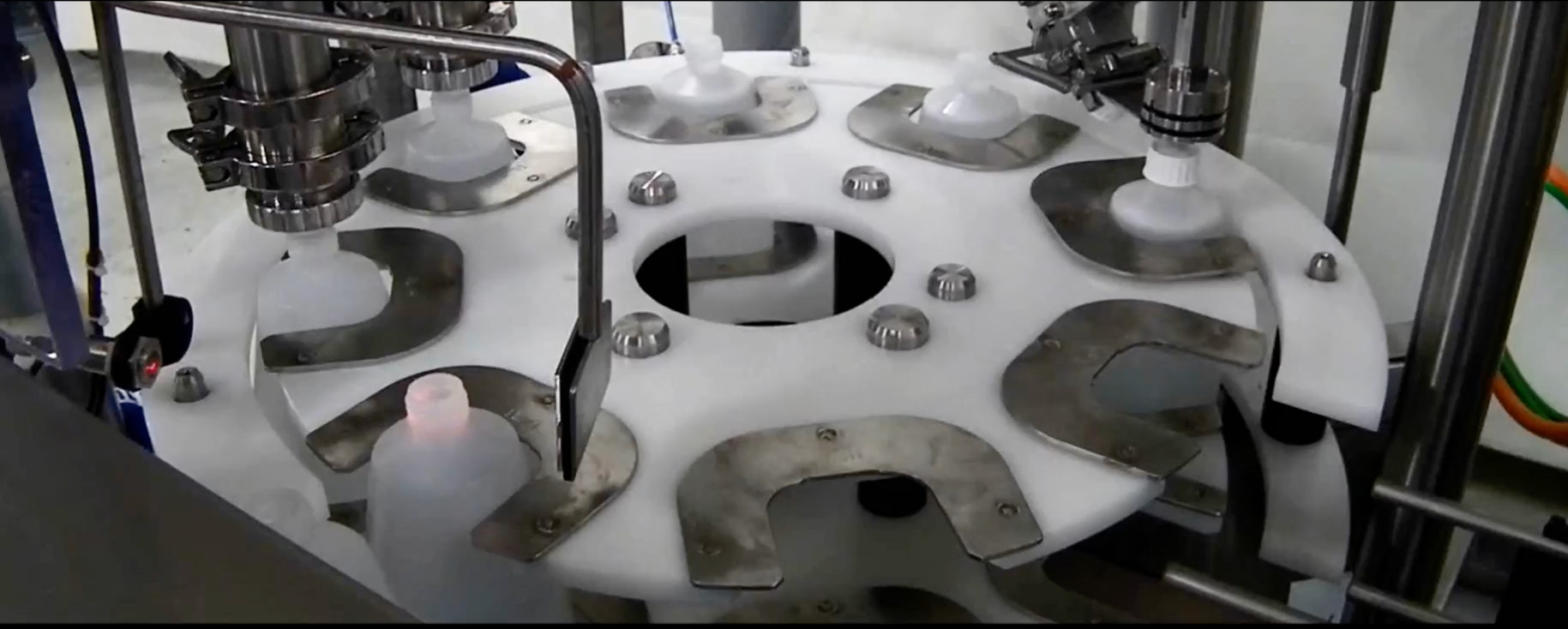
On an intermittent rotary filling machine, also called an indexed rotary machine, containers move step by step. The machine positions the container at a station, stops, performs the operation, and then indexes to the next station.
This intermittent operation often simplifies machine design. Since the container remains stationary during the operation, filling, capping, or dosing stations work under stable conditions.
In practice, this architecture is particularly suitable for production environments requiring flexibility, fast format changes, or a compact machine footprint.
When does an intermittent rotary system become relevant?
An intermittent rotary system becomes relevant when manufacturers need to manage multiple formats, multiple products, or shorter production runs.
Its production rate typically reaches around 30 to 40 cycles per minute, depending on the application. However, this lower speed comes with a significant advantage: the machine remains more compact and mechanically simpler.
In addition, because it often contains fewer parts than a continuous rotary system, it simplifies adjustments and format changes. This becomes a major advantage for manufacturers prioritizing versatility over maximum throughput.
Why is an intermittent rotary system often more flexible?
An intermittent rotary system offers greater flexibility because it relies on a simpler mechanical logic. Containers stop at each station, leaving more room to adjust filling or capping operations.
This architecture also makes it easier to integrate different products or formats, especially when containers do not share exactly the same dimensions.
Finally, the compactness of an intermittent rotary system represents an important advantage when workshop space is limited.
What is the difference between continuous and intermittent rotary filling?
1. Production rate
The continuous rotary system achieves the highest production rates because containers remain in constant motion. It can reach up to approximately 200 cycles per minute in suitable applications.
The intermittent rotary system reaches more moderate production rates, around 30 to 40 cycles per minute. However, it compensates for this limitation through greater simplicity and flexibility.
2. Format flexibility
The continuous rotary system is better suited to single-format production or a maximum of two formats. Beyond that, adjustments become more complex because the machine must synchronize multiple movements.
The intermittent rotary system handles format changes more easily. Thanks to a simpler architecture and fewer parts, interventions are generally faster.
3. Machine footprint
The intermittent rotary system often provides an advantage in terms of footprint. Its more compact design makes integration easier in workshops where space is limited.
The continuous rotary system, by contrast, requires a more complete architecture, particularly with an infeed star wheel, an outfeed star wheel, and additional motorization.
4. Mechanical complexity
The continuous rotary system involves more synchronization. It generally requires more servo motors and more dynamic adjustments.
The intermittent rotary system remains simpler to operate. Since operations take place while the container is stationary, the mechanics can be more straightforward and easier to adjust.
5. Production type
The continuous rotary system is better suited to large production runs and repetitive manufacturing, where throughput is the main priority.
The intermittent rotary system is more appropriate for environments prioritizing versatility, compactness, and fast format changes.
Continuous vs intermittent rotary filling: quick comparison
| Criteria | Continuous rotary | Intermittent rotary |
|---|---|---|
| Operating principle | Continuous container movement | Stop at each station then indexing |
| Typical production rate | Up to approximately 200 cycles/min | Approximately 30 to 40 cycles/min |
| Suitable formats | Single format or maximum 2 formats | Better suited to format changes |
| Container handling | Infeed and outfeed star wheels | Simpler indexing |
| Mechanical complexity | Higher | Lower |
| Servo motors | More numerous | Fewer depending on design |
| Machine footprint | Larger | More compact |
| Format changeover | More complex | Faster |
| Typical application | Large-scale standardized production | Small and medium versatile production runs |
When should you choose a continuous rotary system?
A continuous rotary system should be preferred when throughput is the main priority and production remains highly standardized.
This architecture becomes particularly relevant when manufacturers work with a single format or up to two formats, combined with high volumes and limited changeovers.
It is therefore ideal for filling lines designed to produce quickly, continuously, and with a high level of repeatability.
When should you choose an intermittent rotary system?
An intermittent rotary system should be preferred when flexibility outweighs maximum throughput.
This architecture is especially suitable for manufacturers frequently changing formats, handling multiple products, or working with limited machine space.
Intermittent rotary systems also become relevant when mechanical simplicity, compactness, and fast format changes represent key requirements.
Continuous or intermittent rotary for liquids?
For liquid products, both architectures may be suitable. The choice mainly depends on throughput requirements, product behavior, and the number of formats.
A stable, free-flowing liquid packaged in a standard container may suit a continuous rotary logic. By contrast, a more complex, foamy, viscous, or multi-format product may justify an intermittent approach.
In such cases, the machine must provide sufficient filling stability, especially when the product requires a specific nozzle or a more controlled filling time.
Continuous or intermittent rotary for powders?
For powders, intermittent rotary systems often provide a particular advantage because dosing requires stability.
A vertical auger filler must often maintain good repeatability, limit fines, and ensure clean filling. Stopping the container at each station therefore helps improve dosing consistency and filling control.
However, the final choice always depends on the product, production rate, packaging format, and dosing technology used. In some projects, the choice between volumetric and gravimetric dosing also influences line design.
Why are trials still essential?
Even with a strong initial orientation, the choice between continuous and intermittent rotary filling must be validated using the real product and final packaging.
Trials make it possible to verify achievable throughput, dosing accuracy, filling stability, line cleanliness, and container behavior during the cycle.
They also confirm whether the expected level of flexibility remains compatible with the selected machine architecture.
To secure your project, run filling trials with your product and packaging.
Conclusion
The choice between continuous rotary filling and intermittent rotary filling ultimately comes down to a clear trade-off: maximum throughput or industrial flexibility.
Continuous rotary systems achieve the highest production rates, up to approximately 200 cycles per minute, but they are best suited to standardized production using one or two formats.
Intermittent rotary systems typically reach around 30 to 40 cycles per minute, while offering a more compact, simpler machine with faster format changes.
In all cases, the right choice depends on the product, packaging format, target throughput, and required level of flexibility.
MOM Packaging supports manufacturers in more than 60 countries across Europe, Africa, the Middle East, Oceania, the Americas and East Asia.

Louis Derangère
CEO of MOM Packaging — Industrial automation engineer and precision dosing expert.