
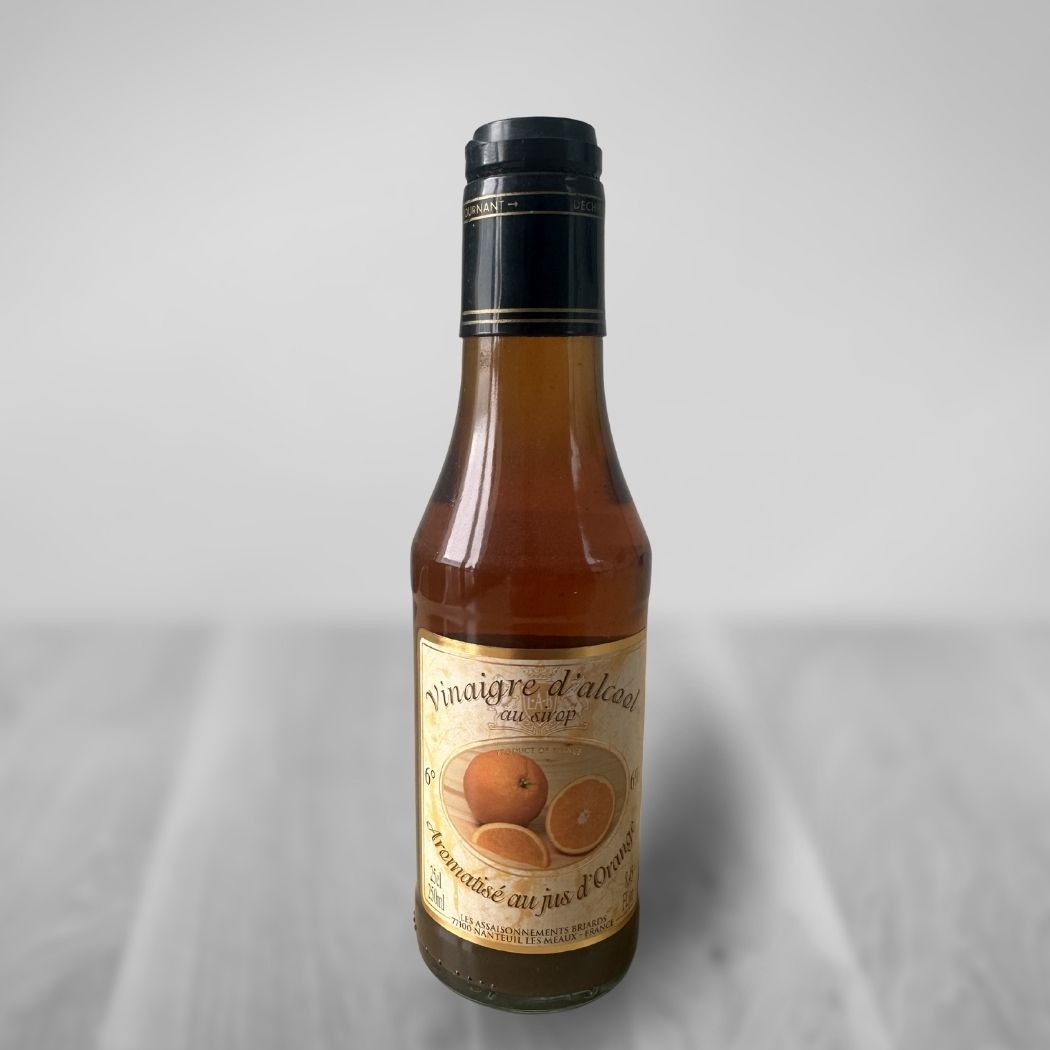
Vinegar filling machine: the essentials in 30 seconds
Technical summary
Vinegar is a corrosive food liquid. The acetic acid it contains attacks metals over time, including 304 stainless steel commonly used in the food industry. Material selection is the first decision to make: 316L stainless steel is mandatory for all product-contact parts, including those located near the bottle neck. Some manufacturers prefer food-grade plastic components for the areas most exposed to acetic vapours.
The range of vinegars to fill is wide: from very fluid and highly corrosive white vinegar to semi-viscous and traceable balsamic vinegar (PGI/PDO), through to flavoured vinegars laden with particles. Each type places different demands on the line.
Two dosing technologies are particularly well suited: constant-level filling for premium transparent bottles, and weight-based dosing for applications where mass accuracy and legal metrology are central criteria.
Why does vinegar filling present specific constraints?
Vinegar is an acidic food product whose corrosiveness is often underestimated in filling projects. Acetic acid, the main constituent of vinegar, behaves differently depending on the materials in contact and the product’s concentration.
The corrosiveness of acetic acid on metals
Acetic acid progressively attacks metal surfaces in contact with the product. Grade 304 stainless steel (or 18/10), commonly used in the food industry, withstands water and most food products well, but it is insufficient against concentrated acetic acid over the long term. 316L stainless steel (austenitic grade with molybdenum) is essential for all parts in direct contact with vinegar.
A frequently overlooked point: parts located near the bottle neck without being in direct contact with the product are exposed to acetic vapours. These vapours are irritating to operators and corrosive to unprotected metal parts. Grade 304 components in this area degrade faster than expected.
Acetic vapours
Acetic acid vapours are released during filling, particularly at high throughput and in confined spaces. They are irritating to operators’ respiratory systems and accelerate corrosion of surrounding equipment. Adequate ventilation of the production area is recommended for high-speed lines.
The wide diversity of vinegars to fill
A single filler may handle vinegars with very different behaviours: very fluid and highly acidic white vinegar, semi-viscous and dense balsamic vinegar, flavoured vinegar containing herb or fruit fragments. Each reference may require a different nozzle and dosing technology.
Legal metrology
Vinegar is a pre-packaged product subject to legal metrology requirements. The net mass or net volume stated on the packaging must correspond to the quantity actually contained in the product. MOM weight-based fillers hold a type-approval certificate for operation under legal metrology.
Traceability requirements
Quality-labelled vinegars (PGI, PDO), notably Modena balsamic vinegar, require strict batch-by-batch traceability. Unit-by-unit production tracking is available on MOM equipment.
What types of vinegar are there, and what are their filling constraints?
| Vinegar type | Acidity | Viscosity | Filling behaviour | Machine constraint |
|---|---|---|---|---|
| White vinegar (spirit vinegar) | 8–12% | Very fluid | Highly corrosive, strong vapours | 316L stainless steel mandatory, ventilation, legal metrology |
| Apple cider vinegar | 5–7% | Very fluid | Corrosive, slightly coloured | 316L stainless steel, anti-drip nozzle, legal metrology |
| Red / white wine vinegar | 6–8% | Very fluid | Corrosive, may contain sediment | 316L stainless steel, weight-based dosing recommended |
| Balsamic vinegar PGI | 6% | Semi-viscous | Dense, coloured, PGI traceability | Weight-based or constant-level dosing, 316L stainless steel |
| Balsamic vinegar PDO (Modena) | ≥ 6% | Viscous | Very dense, very coloured, very high value | High-precision weight-based dosing, mechanical piston, PDO traceability |
| Flavoured vinegar (herbs, fruit) | 5–8% | Fluid with particles | Suspended particles | Gasket flap nozzle, weight-based dosing |
| Industrial spirit vinegar | 8–14% | Very fluid | Highly corrosive, significant vapours | 316L stainless steel or food-grade plastic, reinforced ventilation |
Which materials for a vinegar filling machine?
Material selection is the most important decision in a vinegar filling project. Standard 304 stainless steel equipment will degrade prematurely.
316L stainless steel for all product-contact parts
316L stainless steel is the reference material for vinegar filling. Its molybdenum content gives it superior resistance to acetic acid and acidic environments in general. It is essential for all parts in direct contact with the product: tank, pipework, nozzles, pistons, flap valves.
Watch out for grade 304 parts near the bottle neck
A point often overlooked during line design: parts located near the bottle neck, without being in direct contact with the product, are exposed to acetic vapours. If these parts are in grade 304 stainless steel, they degrade faster than product-contact parts. 316L stainless steel must be specified for all parts near the bottle neck, not only those in direct contact.
Food-grade plastic: an alternative for the most exposed areas
Some manufacturers prefer food-grade plastic components (PEEK, food-grade POM) for the elements most exposed to vapours or for nozzles. These materials are inert to acetic acid and eliminate any corrosion risk. MOM can adapt product-contact parts according to customer preferences.
Acid-resistant food-grade gaskets
Standard silicone or EPDM gaskets can be degraded by acetic acid over time. PTFE (Teflon) or acid-resistant food-grade EPDM gaskets are recommended depending on the vinegar’s concentration.
ANIA certification
MOM provides ANIA food-grade compliance certificates with its machines to confirm the food-grade compliance of product-contact parts. Essential for fillers supplying major retailers and markets subject to quality audits.
Which dosing technology to choose?
Constant-level filling
Particularly suited to premium vinegars filled into transparent glass bottles. It guarantees a visually identical fill level across all packaging units in a given run, which is an essential criterion for products sold on retail shelves. As vinegar density is close to that of water, mass deviations remain limited for standard vinegars. For balsamic vinegars with a higher and more variable density, weight-based dosing is preferable.
Weight-based dosing
Recommended as a first choice for applications subject to legal metrology, for balsamic vinegars (high and variable density), for flavoured vinegars containing particles, and for fillers handling multiple references on the same line. Weight-based dosing directly measures the mass delivered, regardless of product density.
Volumetric dosing
Viable for standard vinegars (white, cider, wine) with a stable, well-controlled density. Less robust than weight-based dosing as soon as the range includes several references with different densities.
Mechanical piston dosing
Reserved for highly viscous, high added-value PDO balsamic vinegars. The mechanical piston guarantees the accuracy and robustness required for these exceptional products.
Which packaging formats for vinegar?
- Glass bottles: the premium format for quality vinegars (balsamic, wine vinegar, organic cider vinegar). Constant-level filling is particularly well suited to this format.
- PET bottles: the dominant format for standard vinegars (white, cider) in mass retail. Compatible with the full MOM range.
- Professional canisters: for catering, the food industry, and professional use. Doses from 1 L to 20 L.
- Flexible sachets and single-dose pouches: for individual formats (catering, hotels). Compatible with ST/DT and 605/623 models.
Complete packaging line for vinegar
MOM offers complete packaging lines for vinegar, integrating:
- Infeed tables and cap unscramblers
- Capping equipment: cork insertion, screw capping, crimping
- Marking or labelling equipment (including capsule application for premium vinegars)
- Quality control: checkweigher, vision system
- Integrated batch-by-batch traceability
Why are trials still essential?
Viscosity and density vary across vinegar types. Actual product behaviour during dosing cannot be predicted from a data sheet. MOM organises trials on your vinegars and your packaging formats to verify:
- mass accuracy and metrological compliance
- dosing cleanliness (no drips, no deposits on the neck)
- material resistance on your specific vinegar (concentration, temperature)
- the behaviour of flavoured vinegars with particles
- cleaning times and reference changeover times
Let’s discuss your specification and production constraints.
Conclusion
Industrial vinegar filling relies on three decisions: selecting the right materials (316L stainless steel for all product-contact parts and parts near the bottle neck, or food-grade plastic depending on preferences), choosing the dosing technology suited to each reference (constant-level for premium bottles, weight-based for balsamic vinegars and legal metrology applications), and ensuring batch-by-batch traceability for quality-labelled products.
MOM Packaging has been filling vinegars and condiments since 1927, from artisan vinegar producers to high-speed lines for mass retail, with food-grade compliance (316L stainless steel, acid-resistant gaskets, ANIA certificates) and legal metrology built in as standard.
MOM Packaging supports manufacturers in more than 60 countries across Europe, Africa, the Middle East, Oceania, the Americas and East Asia.

Louis Derangère
CEO of MOM Packaging — Industrial Automation Engineer and Precision Dosing Expert.