
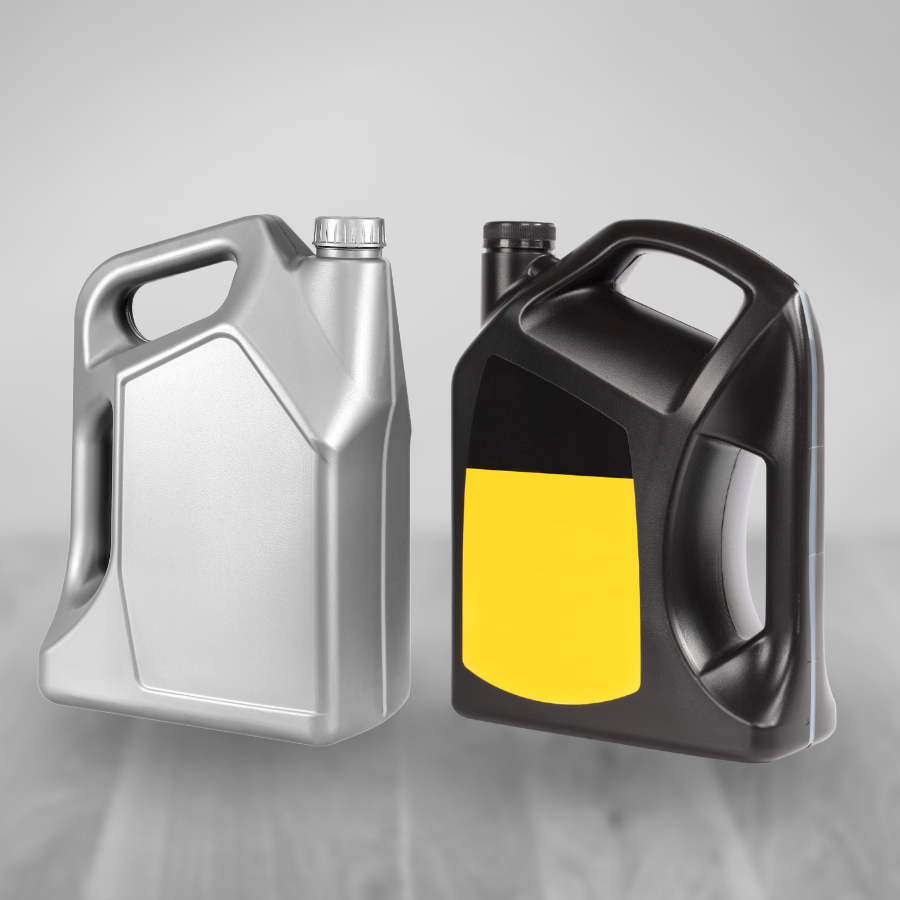
Motor oil filling machine: the essentials in 30 seconds
Technical summary
Motor oils are very fluid liquids whose viscosity varies significantly with temperature. This temperature-dependent behaviour has a direct consequence on dosing accuracy and equipment qualification: a machine qualified cold will not deliver the same results as in hot production conditions. Qualification must be carried out at the same temperature as real production, as metal expansion modifies the machine’s mechanical clearances.
Mechanical piston or servo-motor dosing technology is essential to achieve the required accuracy levels. The pneumatic piston, whose performance depends on the stability of the compressed air supply, is not accurate enough for motor oils.
The valve key dimension (nozzle passage cross-section) must be matched to the product’s fluidity: a very fluid oil such as a 0W20 synthetic requires a small-section valve key to control flow at the end of the dosing cycle.
Why does motor oil filling present specific constraints?
Motor oils are industrial or consumer products subject to high accuracy requirements. Under-dosing or over-dosing has direct consequences on product compliance, production costs, and relationships with OEM customers (vehicle manufacturers) or specialist distribution networks.
A strongly temperature-dependent viscosity
Motor oil viscosity varies considerably with temperature. A 5W30 oil is very fluid when cold (viscosity close to water at low temperature) and significantly more viscous when warm. This variation directly modifies product behaviour during dosing: flow rate, end-of-cycle inertia, nozzle behaviour. If the machine is set up and qualified at a different temperature from the actual production temperature, the measured performance is not representative.
Metal expansion with temperature
The mechanical components of a filling machine expand with heat. Mechanical clearances between the piston and cylinder vary with temperature. A machine qualified at 15°C in a cold workshop will present different clearances than in production at 30°C or 40°C. These variations, even small in absolute terms, can generate significant dosing deviations on small-volume doses. It is therefore essential to qualify the machine at the production temperature, with the real product, in real packaging.
High accuracy requirements
Motor oil fillers supplying vehicle manufacturers (OEM) or specialist distribution networks are subject to strict dosing accuracy specifications. Legal metrology applies to pre-packaged products intended for consumers (1 L, 2 L, 5 L canisters in mass retail). MOM weight-based fillers hold a type-approval certificate for operation under legal metrology.
A critical anti-drip nozzle
Motor oils are greasy products that spread across every surface they touch. A drip at the end of dosing contaminates the canister neck, complicates capping, and degrades the product’s appearance. The valve key dimension plays a decisive role: a passage cross-section that is too large for a very fluid product generates residual flow after the flap closes, producing drips and traces on the canister neck. It must be sized precisely according to the viscosity of each reference.
What types of motor oil are there, and what are their filling constraints?
| Oil type | SAE grade | Viscosity | Filling behaviour | Machine constraint |
|---|---|---|---|---|
| Fully synthetic oil | 0W20, 5W30 | Very fluid when cold | Very low viscosity, amplified drip risk | Small-section valve key, mechanical piston, qualification at production temperature |
| Semi-synthetic oil | 10W40 | Fluid | Intermediate and temperature-dependent viscosity | Mechanical piston recommended, qualification at production temperature |
| Mineral multigrade oil | 15W40, 20W50 | Semi-fluid | More stable viscosity but still temperature-dependent | Mechanical piston, appropriate valve key |
| Transmission / gearbox oil | 75W, 80W90 | Viscous | Thick, flows poorly when cold | Mechanical piston mandatory, temperature maintenance possible |
| Brake fluid | DOT 3/4/5 | Very fluid | Hygroscopic, absorbs moisture, hermetic packaging required | Precise anti-drip nozzle, small-section valve key |
| Antifreeze / coolant | n/a | Fluid | Coloured, may be slightly foaming | Adapted nozzle if foaming, mechanical piston or volumetric |
Why is the pneumatic piston insufficient for motor oils?
Pneumatic piston dosing is driven by a compressed air cylinder. Its performance depends directly on the stability and quality of the compressed air supply: any pressure variation in the network generates a variation in piston force and speed, which translates into a dosing deviation.
For motor oils, where accuracy requirements are high and viscosity varies with temperature, this instability is unacceptable. Two technologies deliver the required accuracy.
Mechanical piston dosing
The mechanical piston is driven by a cam, independently of the compressed air supply. Its movement is determined by the cam geometry: the stroke is precise, reproducible, and insensitive to air supply variations. It is the reference technology for motor oils. More robust and lower-maintenance than the pneumatic piston.
Servo-motor dosing
The servo-motor offers even higher positioning accuracy and greater flexibility on dosing profiles (programmable acceleration and deceleration curves). It is particularly suited to high-speed lines and applications where accuracy is critical across the entire product range. Programming the dosing profile allows the machine’s behaviour to be adapted to each reference without tooling.
The valve key: an often underestimated parameter
The valve key is the component that determines the liquid passage cross-section at the nozzle outlet. Its dimension is a critical parameter for dosing cleanliness on motor oils.
A cross-section that is too large for a very fluid product (0W20 synthetic for example) generates residual inertia at the end of the cycle: the liquid continues to flow after the flap closes, producing drips and traces on the canister neck.
A cross-section that is too small for a more viscous product unnecessarily slows dosing and can produce threads.
The valve key dimension must therefore be selected according to the viscosity of each reference and validated during trials. For a multi-reference range including oils of different viscosities, interchangeable valve keys are required.
Why is qualification at production temperature essential?
This is one of the most specific constraints in motor oil filling and one of the least well anticipated during projects.
Qualifying a filling machine consists of verifying, under defined conditions, that the equipment delivers the expected dose with the required accuracy. This qualification is only valid for the conditions under which it was carried out.
If qualification is performed at a different temperature from the actual production temperature:
- The oil’s viscosity is different, which modifies flow rate and end-of-cycle behaviour.
- Mechanical clearances between the piston and cylinder are different, as metal expands with heat. Wider clearances when warm generate internal leaks that reduce dosing accuracy.
- Qualification results are not representative of actual production conditions.
MOM qualifies its equipment under real production conditions: real product, real temperature, real packaging. IQ/OQ/DQ/PQ qualification protocols are available for customers who need to formally document equipment qualification.
Which packaging formats for motor oils?
- HDPE canisters 1 L, 2 L, 5 L: the dominant formats in mass retail and specialist distribution. Rigid and opaque, compatible with mineral and synthetic oils.
- Professional canisters 20 to 60 L: for garages, professional fleets, and industrial lubricants. Large doses, legal metrology mandatory.
- 205 L drums: for industrial use (machine lubrication, vehicle manufacturers). Top-fill with transfer pump.
- Flexible pouches: an emerging format for single-dose oil pouches (easier oil changes, reduced plastic waste).
Complete packaging line for motor oils
MOM offers complete packaging lines for motor oils, integrating:
- Empty canister infeed and cap removal
- Weight-based or volumetric filling with mechanical piston or servo-motor
- Capping and screw-capping
- Labelling and marking (batch number, production date)
- In-line weight control (checkweigher)
- Integrated batch-by-batch traceability
Why are trials still essential?
Motor oil viscosity varies depending on formulation, temperature, and SAE grade. Actual product behaviour at the nozzle cannot be predicted from a data sheet. MOM organises trials on your oils and your packaging formats to verify:
- dosing accuracy at the actual production temperature
- the right valve key dimension for each reference
- dosing cleanliness (no drips, no traces on the canister neck)
- the behaviour of transmission oils and brake fluids
- reference changeover and cleaning times
Let’s discuss your specification and production constraints.
Conclusion
Industrial motor oil filling relies on three decisions: choosing a mechanical piston or servo-motor to achieve the required accuracy (the pneumatic piston is not suitable), sizing the valve key to the actual viscosity of each reference, and qualifying the machine under real production conditions, particularly at the correct temperature.
MOM Packaging has been filling motor oils, lubricants, and automotive products since 1927, with dosing technologies matched to the requirements of fillers supplying OEM networks and specialist distribution. IQ/OQ qualifications and legal metrology are available as standard.

Louis Derangère
CEO of MOM Packaging — Industrial Automation Engineer and Precision Dosing Expert.