AdBlue filling machine: the essentials in 30 seconds
Technical summary
AdBlue (aqueous urea solution at 32.5%, ISO 22241 standard) is a very fluid, colourless liquid that is easy to fill. Its viscosity is close to that of water. Volumetric or weight-based dosing with a flap nozzle is perfectly suited to this product.
AdBlue crystallises on prolonged contact with ambient air, but this phenomenon is not a parameter to consider for industrial in-line filling: the product is filled continuously, without prolonged air exposure.
The main constraint lies elsewhere: AdBlue releases ammonia vapours during filling. These vapours require local extraction at the filling zone to protect operators and prevent the accumulation of flammable vapours. ATEX precautions may be required depending on the workshop zoning.
ISO 22241 strictly governs the composition, packaging, and materials in contact with AdBlue. It must be integrated from the outset in the line specification.
Why does AdBlue filling present specific constraints?
AdBlue is an aqueous solution composed of 32.5% high-purity urea and 67.5% demineralised water. Its simple formulation and low viscosity make it an easy product to fill. The constraints do not come from the product itself, but from its production environment and the associated normative requirements.
Ammonia vapours and the ATEX constraint
During filling, AdBlue releases ammonia vapours (NH3). These vapours are irritating to operators’ respiratory systems at high concentrations. They can also, in certain workshop configurations, create an explosion risk in the presence of an ignition source.
Two measures are essential:
- Local extraction at the filling zone: vapour capture at source to prevent accumulation in the workshop and protect operators.
- ATEX zone assessment: depending on the ammonia vapour concentration measured in the workshop and the possible presence of other flammable products on the line, ATEX zoning may be required. In this case, all electrical and non-electrical equipment must comply with the applicable technical requirements.
Urea crystallisation: a storage parameter, not a filling one
AdBlue crystallises on prolonged contact with ambient air above a certain vapour concentration. This crystallisation forms characteristic white deposits. It is important to clarify this point: this phenomenon concerns storage and handling, not in-line filling. On a continuously operating filling line, the product circulates without interruption and is not exposed to air for extended periods. No special treatment is required on the machine itself for this reason. However, the feed circuits must be designed to avoid retention zones where the product could stagnate and dry out between production runs.
Sensitivity to metallic contamination
ISO 22241 sets very low thresholds for metallic contamination in AdBlue (iron, copper, zinc, chromium, nickel, aluminium: max. 0.2 to 0.5 mg/kg depending on the metal). These thresholds are very restrictive and require careful selection of materials in contact with the product. The use of non-compliant materials degrades AdBlue quality and may invalidate its ISO 22241 compliance.
Legal metrology requirements
AdBlue is packaged as pre-packaged products intended for sale (5 L, 10 L, 20 L canisters in mass retail and professional distribution). It is therefore subject to legal metrology requirements. MOM weight-based fillers hold a type-approval certificate for operation under legal metrology.
Which materials for an AdBlue filling machine?
ISO 22241-3 governs the materials compatible with AdBlue. Two families are permitted.
Appropriate-grade plastics
HDPE (high-density polyethylene) and PVC are the reference materials for AdBlue product-contact parts. They are inert to the urea solution and do not generate metallic contamination. AdBlue packaging (canisters, IBCs) is systematically in HDPE for this reason.
316L stainless steel
316L stainless steel is compatible with AdBlue. Its corrosion resistance is sufficient for dosing and transfer applications. However, lower-grade stainless steels (304) or those containing copper, zinc, or nickel in excessive quantities may generate contamination beyond ISO 22241 thresholds. The compliance of materials used must therefore be verified against the standard’s thresholds.
Materials to avoid
AdBlue is incompatible with copper, brass, zinc, unprotected nickel, and untreated aluminium. These materials are attacked by the urea solution and generate metallic contamination that degrades product quality. All line components (pumps, valves, fittings, nozzles) must be checked.
Which dosing technology to choose for AdBlue?
AdBlue is a very fluid liquid (viscosity close to water, density 1.087–1.093 kg/dm³). Its dosing behaviour is simple and predictable.
Volumetric dosing with a flap nozzle
This is the most suitable solution for AdBlue. As the product is very fluid and homogeneous, volumetric dosing is accurate and consistent. A simple flap nozzle is perfectly appropriate: metal-to-metal seal, easy to clean, no risk of threads or foam.
Weight-based dosing
Recommended for applications subject to legal metrology, or for lines filling several references with slightly different densities (standard AdBlue vs additivated AdBlue, whose density may vary slightly). Weight-based dosing compensates for these variations automatically.
Which packaging formats for AdBlue?
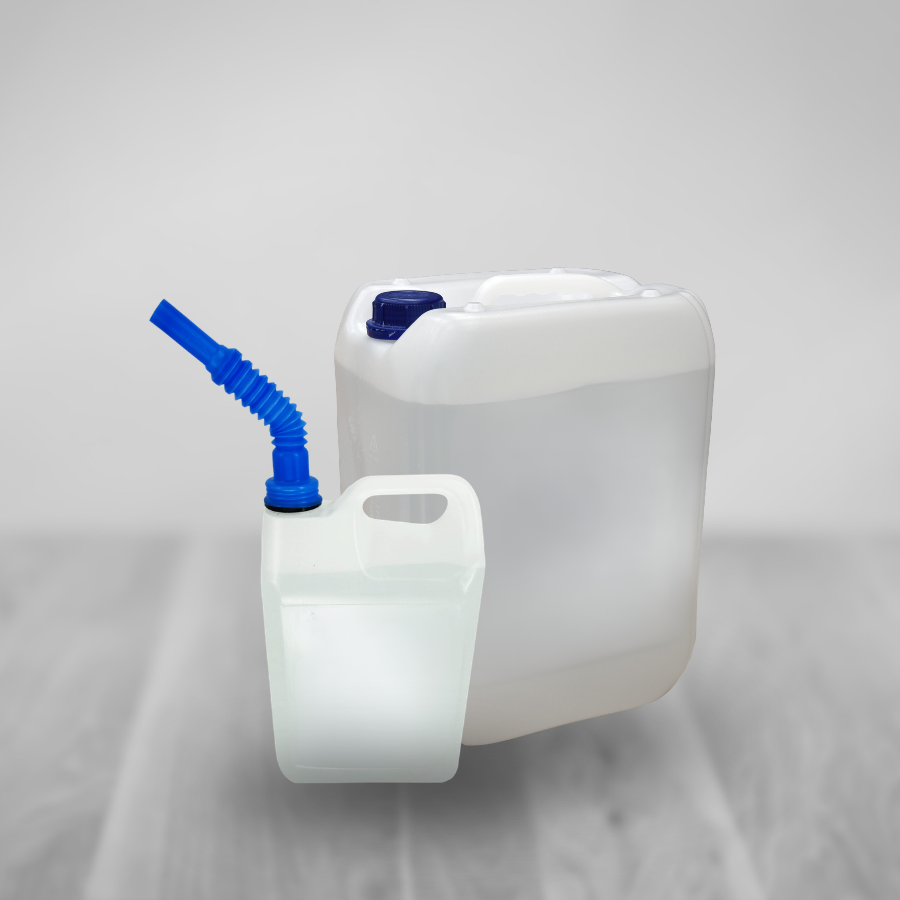
- HDPE canisters 5 L, 10 L, 20 L: the dominant format in mass retail and petrol stations. Safety caps with a dedicated AdBlue spout (standardised to prevent confusion with diesel).
- Professional canisters 60 to 210 L: for professional fleets, garages, and maintenance workshops.
- IBC (Intermediate Bulk Container) 1,000 L: for large consumers (transport operators, agriculture, construction). Top-fill with transfer pump.
One point to note: AdBlue caps and spouts are standardised to prevent any confusion with diesel (green spout, different diameter). The packaging line must be compatible with these specific closure formats.
Extraction and operator safety: how to organise the line?
Managing ammonia vapours is the central safety constraint on an AdBlue filling line. The following measures must be integrated from the design stage.
- Local extraction: a vapour capture system must be installed as close as possible to the filling zone, ideally at the nozzle level. The objective is to capture vapours at source before they disperse into the workshop.
- General workshop ventilation: in addition to local extraction, general ventilation of the production area is recommended.
- ATEX zone assessment: ATEX zone calculations must be carried out by a qualified engineering firm, taking into account the ammonia vapour flow rate, workshop volume, and ventilation in place. MOM manufactures equipment compliant with ATEX requirements for zones requiring certified equipment.
- Operator PPE: protective goggles and gloves are recommended during maintenance operations on circuits in contact with AdBlue.
ISO 22241 standard: what it means for your line
The ISO 22241 standard is divided into four parts:
- ISO 22241-1: product quality specifications (composition, contamination thresholds)
- ISO 22241-2: test methods
- ISO 22241-3: good practices for handling, transport, and storage — this is the part that governs compatible materials and packaging precautions
- ISO 22241-4: vehicle filling interface
For a filler, parts 1 and 3 are primarily applicable. They define the purity thresholds to be met at the packaging output and the authorised materials for product-contact equipment. Failure to comply with these specifications may invalidate the ISO 22241 compliance of the filled product.
Why are trials still essential?
AdBlue is an easy product to fill, but real-condition validation remains necessary to confirm performance on your specific packaging formats and to verify material compatibility with your ISO 22241 requirements. MOM organises trials on your products and your packaging formats to verify:
- dosing accuracy and metrological compliance
- material compatibility with ISO 22241 thresholds
- dosing cleanliness (no drips on the neck or cap)
- the behaviour of the extraction system on the real line
- cleaning times between production runs
Let’s discuss your specification and production constraints.
Conclusion
Industrial AdBlue filling relies on three decisions: selecting materials compliant with ISO 22241 (HDPE or 316L stainless steel, without copper, brass, zinc, or untreated aluminium), implementing local extraction to manage ammonia vapours and assessing ATEX zoning, and validating metrological compliance through accurate weight-based or volumetric dosing.
MOM Packaging has been filling chemical and automotive products since 1927, with ATEX precautions, IQ/OQ qualifications, and legal metrology available as standard. Find out more about our ATEX liquid filling machines.

Louis Derangère
CEO of MOM Packaging — Industrial Automation Engineer and Precision Dosing Expert.