
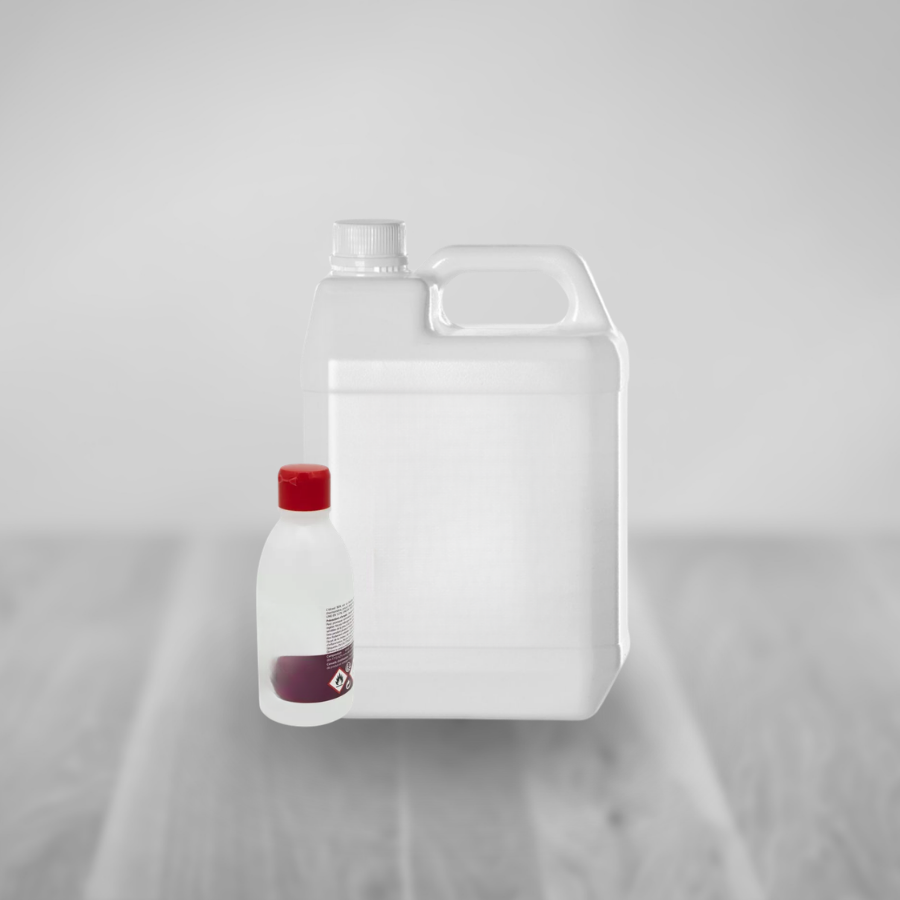
Denatured alcohol filling machine: the essentials in 30 seconds
Technical summary
Denatured alcohol (denatured ethanol at 70–96%) is a very fluid, colourless and non-foaming liquid. Its dosing behaviour is straightforward: a flap nozzle with a good metal-to-metal seal is perfectly suited.
The central constraint is not the product itself, but its production environment: alcohol is classified as a highly flammable liquid (flash point ≈ 13°C for 96% ethanol). Its vapours form explosive mixtures with air within the limits of 3.3 to 27.7% by volume. The filling zone is an ATEX zone requiring local extraction as close as possible to the filling nozzle and certified equipment.
Alcohol is not corrosive to metals. Product-contact parts are in stainless steel. A specific constraint applies to plastic components: no PVC part larger than 100 mm × 100 mm must be present in the dosing zone, to prevent any risk of electrostatic charge accumulation that could generate a spark.
Why does denatured alcohol filling present specific constraints?
Denatured alcohol is ethanol rendered unfit for consumption by the addition of denaturing substances (methanol, ethyl acetate, methyl isobutyl ketone…). It retains all the physical properties of ethanol, notably its high flammability and volatility.
A highly flammable liquid with explosive vapours
Ethanol is classified as a highly flammable liquid (H225) under CLP regulations. Its closed-cup flash point is approximately 13°C for 96% ethanol, a temperature well below normal workshop working conditions. As soon as ambient temperature exceeds 13°C, the product emits sufficient vapours to form an explosive mixture with air in the presence of an ignition source.
Ethanol vapours are heavier than air. They accumulate at floor level and in low-lying areas of the workshop, particularly near filling machines. They can travel some distance and cause flashback from a remote ignition source.
The filling zone is an ATEX zone
The denatured alcohol filling zone is systematically classified as an ATEX zone (zone 1 or zone 2 depending on the frequency of vapour occurrence and the ventilation in place). This classification requires:
- ATEX-certified electrical and non-electrical equipment (motors, sensors, wiring, lighting).
- Local extraction as close as possible to the filling nozzle, to capture vapours at source before they accumulate in the working area.
- Earthing and electrical continuity on all metallic elements of the line to prevent electrostatic discharges.
- The absence of ignition sources in the zone (no spark-producing tools, no naked flames).
The electrostatic risk: the constraint on plastic components
Alcohol is a good carrier of electrostatic charges. As the product flows through pipework and at the filling nozzle, electrostatic charges can accumulate on insulating surfaces. If this accumulation reaches a sufficient threshold, the discharge can produce a spark in an atmosphere rich in alcohol vapours.
To prevent this risk, a design rule applies on denatured alcohol filling lines: no insulating plastic component (PVC in particular) larger than 100 mm × 100 mm must be present in the dosing zone. Beyond this dimension, the component’s surface area is sufficient to accumulate a dangerous electrostatic charge. Product-contact parts must therefore be in stainless steel or suitable conductive materials, and large-dimension plastic fittings are prohibited.
A non-corrosive, easy-to-fill product
Unlike bleach or vinegar, denatured alcohol is not corrosive to common metallic materials. Ethanol is inert towards stainless steel, anodised aluminium and most steels. PTFE (Teflon) gaskets are recommended for their resistance to organic solvents and their compatibility with ethanol.
From a dosing perspective, behaviour is simple: very fluid liquid, non-foaming, stable density (0.789 to 0.816 g/cm³ depending on concentration). Volumetric dosing with a simple flap nozzle is perfectly suited.
What constraints actually affect denatured alcohol filling?
| Constraint | Impact on filling | Technical element required |
|---|---|---|
| Low flash point (≈ 13°C) | Explosive vapours under normal working conditions | ATEX zoning, certified equipment, local extraction |
| Vapours heavier than air | Accumulation at floor level and in low-lying areas | Extraction at nozzle level, low-level workshop ventilation |
| Electrostatic risk | Charge accumulation on insulating plastic parts | No PVC part > 100 mm × 100 mm, earthing, electrical continuity |
| Very fluid product | Drip risk at end of dosing | Simple flap nozzle with precise metal-to-metal seal |
| Non-corrosive | No special constraint on metals | Standard stainless steel, PTFE gaskets recommended |
| Legal metrology | Requirements on pre-packaged 5 to 20 L canisters | Weight-based or volumetric dosing certified for legal metrology |
Which dosing technology to choose?
Volumetric dosing with a flap nozzle
This is the most suitable solution for denatured alcohol. The product is very fluid, homogeneous and non-foaming. A simple flap nozzle, sealed by metal-to-metal contact, is perfectly appropriate. It prevents drips at the end of dosing, is easy to clean, and can be autoclaved without disassembly. The nozzle passage cross-section must be adjusted to the product’s fluidity to control residual inertia at the end of the cycle.
Weight-based dosing
Recommended for applications subject to legal metrology, or for lines filling several alcohol concentrations (70%, 90%, 96%) whose densities differ. Weight-based dosing guarantees net mass regardless of batch concentration.
Which packaging formats for denatured alcohol?
- HDPE canisters 5 L and 20 L: the dominant formats for professional and mass-market distribution. Canisters are opaque (vapour protection) and fitted with airtight caps.
- 205 L drums: for industrial users and bulk distributors.
- 975 L cubitainers / IBCs: for large industrial quantities.
The packaging line must be designed so that containers are closed as quickly as possible after filling, to limit vapour emissions in the workshop.
Extraction and ATEX zoning: how to organise the line?
Safety on a denatured alcohol filling line relies on eliminating all ignition sources in the ATEX zone and controlling vapour concentrations.
- Local extraction at the filling nozzle: vapour capture at source, as close as possible to the emission point. This is the most effective measure for keeping vapour concentration below the lower explosive limit (LEL = 3.3% by volume).
- General workshop ventilation: low-level ventilation to remove dense vapours that accumulate at floor level.
- Systematic earthing: all metallic elements of the line (machine, tank, pipework, packaging) must be connected to earth to prevent electrostatic discharges.
- Electrical continuity: electrical connections between metallic parts must be verified and maintained. A plastic fitting interposed between two metallic parts interrupts continuity and creates an electrostatic accumulation point.
- ATEX-certified equipment: all electrical and non-electrical equipment in the classified zone must be certified for gas group IIB (ethanol). MOM manufactures ATEX liquid filling machines suited to these environments.
Why are trials still essential?
Real-condition validation allows dosing cleanliness to be verified and confirms correct sizing of the extraction system on the actual line. MOM organises trials on your products and your packaging formats to verify:
- dosing accuracy and metrological compliance
- dosing cleanliness (no drips, no traces on the canister neck)
- the effectiveness of local extraction on the real line
- electrical continuity and earthing of the entire line
- format changeover and cleaning times
Let’s discuss your specification and production constraints.
Conclusion
Industrial denatured alcohol filling relies on three decisions: correctly classifying the filling zone as an ATEX zone and equipping the line accordingly (local extraction, certified equipment, earthing), eliminating all electrostatic risk by prohibiting large insulating plastic components (no PVC > 100 mm × 100 mm), and selecting a flap nozzle suited to the product’s fluidity to guarantee dosing cleanliness.
MOM Packaging has been filling alcohols and industrial solvents since 1927, with ATEX precautions, earthing, and electrical continuity built in as standard. Find out more about our ATEX liquid filling machines.

Louis Derangère
CEO of MOM Packaging — Industrial Automation Engineer and Precision Dosing Expert.