
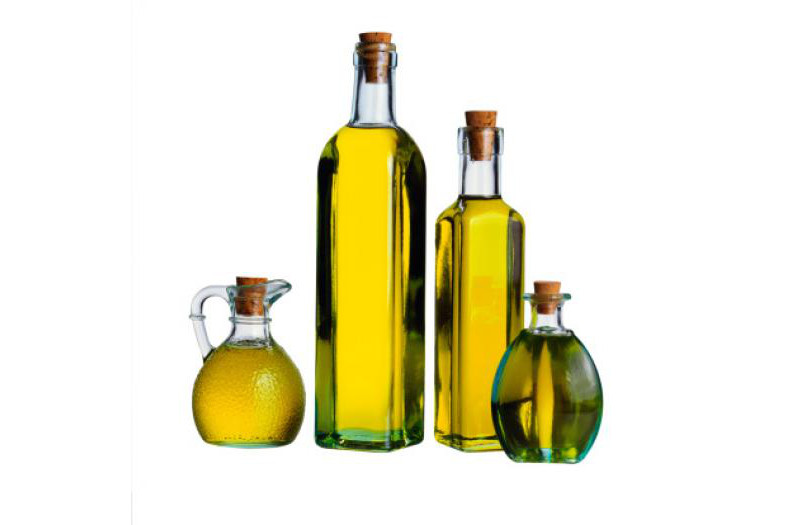
Edible oil filling machine: the essentials in 30 seconds
Technical summary
Edible oils appear to be a homogeneous product family, but their behaviour varies significantly depending on the formulation: stable and fluid for sunflower or rapeseed oil, temperature-sensitive for coconut or palm oil, particle-laden for flavoured oils, semi-viscous for nut butters.
The choice of an edible oil filling machine therefore depends on the precise nature of the product, not only on throughput. The greasy, wetting nature of oils amplifies every dosing defect: a drip on the neck or thread contaminates the packaging, prevents proper capping, and compromises label adhesion.
Weight-based dosing is recommended whenever the range includes several oils with different densities, or when legal metrology requirements apply. Food-grade material compliance for product-contact parts (316L stainless steel, food-grade gaskets, ANIA certificates) is a non-negotiable prerequisite.
Why does edible oil filling present specific constraints?
Edible oils are fluid to semi-viscous liquids, but their characteristics vary significantly depending on origin, formulation, and temperature. A manufacturer filling several oil references faces very different behaviours on the same line.
The greasy and wetting nature of oils
Oils spread across every surface they touch. A drip at the end of dosing does not stay localised: it spreads along the bottle neck, runs down the thread, and compromises capping. The cap slips, the seal is not guaranteed, and labels do not adhere properly to a contaminated bottle. Dosing cleanliness is therefore a central selection criterion for edible oil filling.
Variable density across references
Each oil has a different density: sunflower oil, extra-virgin olive oil, and coconut oil do not have the same mass per unit volume. If a volumetric line is calibrated for one reference, the same volume dosed on another reference will not deliver the same net mass. Legal metrology requirements apply to the net mass stated on the packaging, not the volume. Weight-based dosing compensates for these variations automatically.
Temperature sensitivity of certain oils
Coconut oil and palm oil change state depending on temperature: they are solid below approximately 25°C and liquid above it. If product temperature in the tank, pipework, or nozzles is not maintained, the product solidifies and blocks the line. Temperature maintenance of the product feed circuits is essential for these references.
Particles in flavoured oils
Flavoured oils (garlic, chilli, herbs, truffle…) contain fragments or particles in suspension. These particles can block a simple flap nozzle whose mechanical clearances are precise. Oversized gasket flap nozzles are required, or weight-based dosing to manage the variability in particle distribution within the dose.
Traceability and cleaning requirements
Organic oils and quality-labelled oils (PDO, PGI) require strict batch-by-batch traceability. In multi-reference production, cleaning between two oils must eliminate any cross-contamination risk, particularly between a conventional and an organic oil.
What are the types of edible oils and their filling behaviour?
Not all edible oils fill the same way. The table below summarises the main references and their characteristics in industrial filling.
| Oil type | Approx. viscosity (mPa.s at 20°C) | Filling behaviour | Key consideration |
|---|---|---|---|
| Sunflower oil | 50–65 | Very fluid, flows freely | Drip risk at end of dosing |
| Rapeseed oil | 65–80 | Fluid | Drip risk at end of dosing |
| Virgin olive oil | 70–90 | Fluid, slightly denser | Density varies by origin and harvest |
| Extra-virgin olive oil | 80–110 | Fluid, variable density | Weight-based dosing recommended for legal metrology |
| Sesame oil | 60–80 | Fluid | Drip risk at end of dosing |
| Coconut oil (> 25°C) | 25–30 | Very fluid when warm | Solidifies below 25°C: temperature maintenance mandatory |
| Palm oil (liquid) | 40–50 | Fluid but temperature-sensitive | Solidifies quickly: temperature maintenance mandatory |
| Flavoured oil (garlic, herbs, chilli…) | Variable | Fluid with suspended particles | Nozzle blockage risk; weight-based dosing recommended |
| Peanut butter / almond butter | 150–200+ | Semi-viscous to viscous | Mechanical piston dosing required |
| Chocolate spread | 5,000–50,000 | Viscous to pasty | Mechanical piston, temperature maintenance |
Which dosing technology to choose for edible oils?
Volumetric dosing
Suited to fluid oils with a stable, well-controlled density across all batches. Achieves high throughput rates. As soon as the range includes several references with different densities, or when legal metrology requirements apply, volumetric dosing alone is not sufficient.
Weight-based dosing
Recommended whenever the range includes several oils with different densities, or when metrological compliance is a criterion. Weight-based dosing directly measures the mass delivered, regardless of product density. It is the most robust solution for a manufacturer filling several oil references on the same line. MOM weight-based fillers hold a type-approval certificate for operation under legal metrology.
Mechanical piston dosing
Required for semi-solid vegetable fats and nut butters (peanut butter, almond butter…) whose viscosity is too high for gravity or standard volumetric dosing. The mechanical piston is recommended for its accuracy and robustness on high added-value products.
Which packaging formats for edible oils?
Edible oils are filled into a wide variety of packaging formats, each placing specific demands on the line.
- PET bottles: the most common format for mass-market oils. Rigid packaging, compatible with the full MOM range.
- Glass bottles: for premium oils (PDO olive oil, organic oils, flavoured oils). Glass requires careful infeed handling to prevent breakage.
- Canisters and jerricans: for professional formats (food service, food industry). Doses from 1 L to 20 L depending on the model.
- Flexible pouches and sachets: for single-dose formats or bulk packaging. Compatible with ST/DT and 605/623 models.
Which filling machine to choose based on throughput?
More than 14,000 units / day
A high-speed filling line (671R type) is the right choice. These lines provide real-time collection of individual packaging data and batch-by-batch production tracking, essential for organic oils and quality-labelled references.
Between 4,000 and 14,000 units / day
A filling-capping monobloc (ST69 / Dosamatic type) combined with a labeller meets the requirement. Product-contact components are tool-free removable to facilitate reference changeovers.
Between 3,000 and 6,000 units / day
Two solutions are possible depending on the number of references and packaging types:
- a medium-speed monobloc
- two semi-automatic lines running in parallel
Fewer than 3,000 units / day
A semi-automatic machine (605 / 623 type) is the right fit. A flexible solution, it handles several oil references with a single piece of equipment by simply changing nozzles and adjusting the dosing setpoint.
Food-grade compliance: what are the machine requirements?
Edible oil filling imposes strict requirements on materials in contact with the product.
- 316L stainless steel: all rigid parts in contact with the oil are in 316L stainless steel, the reference grade for food applications.
- Food-grade gaskets: gaskets are food-grade quality, compatible with vegetable oils.
- ANIA certificates: MOM provides food-grade compliance certificates (ANIA) for product-contact parts.
- No retention zones: MOM machines are designed without retention zones to facilitate cleaning and prevent oil deposits between production runs.
- Traceability: MOM equipment enables batch-by-batch or unit-by-unit production tracking.
Why are trials still essential?
The viscosity of an oil varies with its temperature, origin, and formulation. The actual behaviour of the product in the packaging, particularly drip formation at the end of dosing, cannot be predicted from a data sheet. MOM organises trials on your oils and your packaging formats to verify:
- dosing cleanliness (no drips, no traces on the neck or thread)
- mass accuracy on each reference
- the behaviour of temperature-sensitive oils at production temperature
- nozzle compatibility with any particles present in the product
- cleaning times and reference changeover times
Let’s discuss your specification and production constraints.
Conclusion
Industrial edible oil filling relies on three decisions: characterising each reference in the range (viscosity, density, particles, temperature sensitivity), selecting the appropriate dosing technology (weight-based as a priority when several densities are involved), and ensuring food-grade compliance of product-contact materials.
MOM Packaging has been designing edible oil filling machines since 1927, from high-speed lines to semi-automatic equipment, with food-grade compliance (316L stainless steel, food-grade gaskets, ANIA certificates) and legal metrology built in as standard.
MOM Packaging supports manufacturers in more than 60 countries across Europe, Africa, the Middle East, Oceania, the Americas and East Asia.

Louis Derangère
CEO of MOM Packaging — Industrial Automation Engineer and Precision Dosing Expert.