Detergent filling machine: the essentials in 30 seconds
Technical summary
Detergents cover a wide range of products: foaming, viscous and corrosive liquids, often within the same product range. Finding a detergent filling machine versatile enough to handle an entire catalogue while meeting accuracy, throughput and cleanability requirements is a central challenge.
A single machine can fill any type of liquid detergent, provided it is fitted with interchangeable nozzles and the right dosing technology for each product’s viscosity. Weight-based dosing is recommended whenever accuracy and consistency are important criteria. Cleanability, via a machine that is easy to disassemble or CIP-compatible, is a selection criterion as important as throughput.
Why does detergent filling present specific constraints?
Detergents are a highly heterogeneous product family. A single manufacturer may need to fill products with very different behaviours: fluid foaming washing-up liquid, semi-viscous laundry detergent, corrosive multi-surface cleaner, viscous toilet gel. Each product places different demands on the filling machine.
A very wide viscosity range
Depending on the formulation, detergent viscosity can range from a very fluid liquid (close to water) to a thick gel. This variability requires interchangeable nozzles suited to each product type. Depending on viscosity, filling will be performed by gravity or with the help of a transfer pump.
Some products are corrosive
Certain detergents are corrosive: chlorinated products, acids, bases. These products attack the materials in contact with the liquid, particularly stainless steel. The choice of machine materials is critical to guarantee equipment durability and operator safety.
A strong accuracy requirement
Large doses and the need to comply with legal metrology requirements impose precise and repeatable dosing, regardless of the product being filled. Weight-based dosing meets this requirement better than volumetric or flow-meter dosing.
Frequent recipe changeovers
In multi-product production, recipe changeovers are common. Machine cleanability, ease of disassembly or CIP compatibility, directly conditions line productivity.
What constraints actually affect detergent filling?
| Product constraint | Impact on filling | Technical element required |
|---|---|---|
| Variable viscosity across references | A single nozzle does not suit the whole range | Interchangeable nozzles; gravity or pump depending on viscosity |
| Foaming product | Neck contamination, capping problems | Spout nozzle preferred over diving nozzle |
| Viscous product | Threads at end of dosing, reduced accuracy | Flap nozzle suited to the viscosity |
| Corrosive product (chlorinated, acid, base) | Material degradation, operator risk | Special equipment (inert materials, drip tray) |
| Large doses / legal metrology | Unacceptable dosing deviation with volumetric | Weight-based dosing |
| Frequent recipe changeovers | Downtime for cleaning | CIP, tool-free disassembly, recovery tray |
Which filling nozzle to choose for detergents?
A machine fitted with interchangeable nozzles is essential to handle an entire detergent range with a single piece of equipment.
For foaming detergents
Prefer a spout nozzle over a diving nozzle. Simpler to use (no adjustment required), it prevents contamination without reducing throughput.
For viscous detergents
Use flap nozzles suited to the product’s viscosity. For the most viscous products, a mechanical piston dosing system is recommended.
For corrosive detergents
Special equipment is required for corrosive and chlorinated detergents: inert materials, drip tray, epoxy treatment.
Which dosing technology to choose?
For equipment that is fast, simple and accurate, even on large doses, choose a weight-based filling machine rather than a volumetric or flow-meter system. Weight-based dosing compensates for density variations from one batch to another and guarantees mass accuracy regardless of the formulation.
For cleanability: choose equipment that is easy to disassemble or that allows clean-in-place (CIP). On automatic machines, a recovery tray also significantly reduces cleaning time in the event of a line incident.
Which filling machine to choose based on throughput?
More than 14,000 units / day
A high-speed filling line is the right choice. These lines provide real-time collection of individual packaging data and production data analysis for decision support.
Between 4,000 and 14,000 units / day
A filling-capping monobloc combined with a labeller meets the requirement. To simplify format changeovers, components are tool-free removable, this is what is known as plug & play format changeover or SMED.
Between 3,000 and 6,000 units / day
Two solutions are possible depending on the number of references and product types:
- a medium-speed monobloc
- two semi-automatic lines running in parallel
Fewer than 3,000 units / day
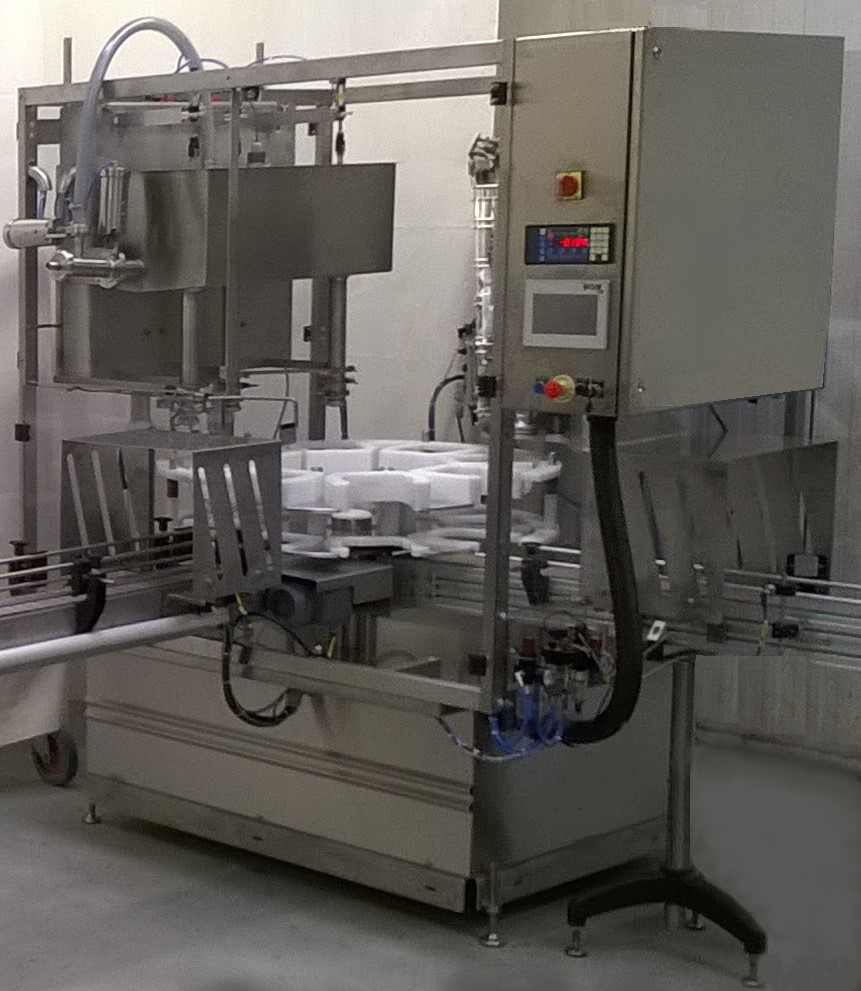
A semi-automatic machine is the right fit. A flexible solution, it handles multiple references with a single piece of equipment by simply changing nozzles.
Complete packaging line for detergents
To limit the number of operators on a production line, MOM offers complementary upstream and downstream equipment, up to a line operated by a single person. Examples include:
- Rotary or linear infeed tables, bottle unscramblers, infeed robots
- Marking or labelling equipment
- Quality control elements: vision systems, checkweighers
- Accumulation tables, manipulators, case packers
MOM also builds filling-capping monoblocs for applications requiring a compact footprint.
For additional constraints, corrosive products, explosive products, ATEX requirements, vapour emissions, MOM manufactures special-purpose equipment.
Find all liquid filling machines manufactured by MOM.
Why are trials still essential?
To secure a detergent filling project, validation under real conditions remains the key step. MOM organises trials on your products and packaging formats to verify:
- the right nozzle for each reference (foaming, viscous, corrosive)
- filling accuracy and achievable throughput
- dosing cleanliness across the entire range
- cleaning times and recipe changeover times
Let’s discuss your specification and production constraints.
Conclusion
Industrial detergent filling relies on three decisions: choosing equipment versatile enough to handle the entire range, selecting the right dosing technology (weight-based as a priority) and the nozzles suited to each product, and ensuring efficient cleanability to minimise downtime between recipes.
MOM Packaging has been designing detergent filling machines since 1927, from high-speed lines to semi-automatic equipment, including for corrosive products, foaming products and ATEX applications.