Bleach filling machine: the essentials in 30 seconds
Technical summary
Bleach (sodium hypochlorite) is one of the most demanding products to fill industrially. Chlorine is the enemy of stainless steel: it attacks product-contact parts but also the surrounding metal components exposed to vapours. Material selection is the first decision to make before any other consideration.
The range of products to fill is wide: from a flexible concentrate refill pouch of 250 mL at 9.6% active chlorine to a 25 L industrial jerrycan at 14–15% active chlorine. Each format places different demands on the line.
Weight-based dosing is recommended to ensure metrological compliance, as bleach density varies with its active chlorine concentration. The line must also incorporate a drip tray, appropriate ventilation, and spout nozzles if the product is foaming.
Why does bleach filling present specific constraints?
Bleach is a corrosive, highly alkaline, and chemically unstable product. These three combined properties impose very specific requirements on filling equipment.
Chlorine corrosiveness on materials
Chlorine is one of the main enemies of stainless steel. It causes pitting corrosion that progressively degrades product-contact surfaces. But the constraint does not stop at direct-contact parts: chlorine vapours released during filling also attack all unprotected metal parts near the machine (fasteners, bolts, frame). A machine built in standard stainless steel degrades rapidly in this environment.
High alkalinity
Bleach is a highly alkaline product (high pH). This alkalinity contributes to material degradation and requires careful gasket selection. Certain common elastomer materials do not withstand strongly alkaline products.
Chemical instability
Active chlorine degrades over time, with heat, and with light exposure. Active chlorine concentration decreases after manufacture, which imposes short shelf lives on concentrated products (2 to 3 months for 9.6% refill pouches). Filling speed is therefore a direct economic issue: the faster the product is filled after manufacture, the longer its shelf life.
Vapours and operator safety
Chlorine vapours released during filling are toxic to operators and corrosive to surrounding equipment. Adequate ventilation of the production area is mandatory. A drip tray under the machine is essential to contain any accidental spill and protect floors, operators, and the environment.
Foaming tendency
Some bleach formulations include surfactants (bleach + detergent). These products generate foam during filling. A spout nozzle is then essential to prevent contamination of the bottle neck and thread.
What types of chlorinated products are there, and what are their filling constraints?
The range of chlorinated products to fill is wide. Each format and each concentration places specific demands on the line.
| Format | Concentration | Sector | Packaging | Machine constraint |
|---|---|---|---|---|
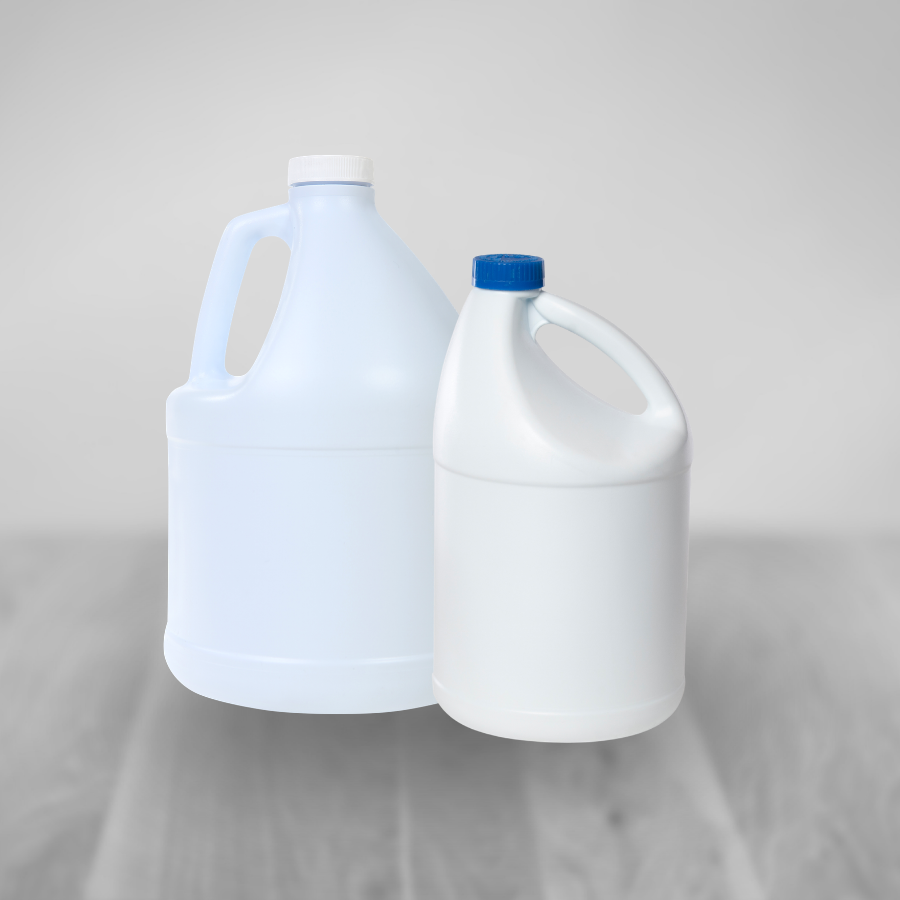
| Ready-to-use bleach | 2.6% active chlorine (≈ 9°chl) | Consumer, public services | Rigid PET bottle 1 to 2 L, child-safety cap | High throughput, legal metrology, anti-drip nozzle |
| Concentrated refill pouch | 9.6% active chlorine (≈ 36°chl) | Consumer | Flexible pouch 250 mL | Flexible packaging filling, high corrosivity, short shelf life |
| Professional bleach extract | 14–15% active chlorine (≈ 48°chl) | Industry, public services, swimming pools | HDPE jerrycan 5 to 25 L | Large doses, weight-based dosing mandatory, reinforced drip tray |
| Hospital-grade solution | ≈ 3.8% active chlorine (12°chl) | Healthcare, laboratories | Dedicated bottles | Batch traceability, weight-based accuracy, IQ/OQ qualifications |
| Scented bleach / with surfactants | Variable | Consumer | PET bottle 1 to 2 L | Foaming: spout nozzle essential |
Which materials for a bleach filling machine?
This is the most important technical decision. A bleach filling machine cannot be built like a standard stainless steel machine.
PVC for product-contact parts
Parts in direct contact with bleach are built in PVC. This material withstands the corrosivity of chlorine and alkaline products. Tanks have cone-bottom design to eliminate product retention zones.
Epoxy treatment for metal parts
Where certain parts must be metallic for mechanical reasons, they receive an epoxy paint treatment to protect them from chlorine vapours.
Protected fasteners or inert material screws
Fasteners are protected with plastic caps or replaced with screws made from inert materials such as PEEK. Without this precaution, fasteners corrode rapidly under vapour exposure, even without direct contact with the product.
Drip tray
A drip tray under the machine is essential. It protects operators, floors, and the environment in the event of accidental spillage. It is also required by regulations for corrosive and hazardous products.
Opaque plastic packaging only
Bleach is never filled into transparent glass or stainless steel containers. Packaging is in PET, HDPE or PVC, opaque to protect active chlorine from light-induced degradation.
Which dosing technology to choose?
Weight-based dosing
Recommended as a first choice. Bleach density varies with its active chlorine concentration (from 1.07 to 1.22 depending on the formulation). A volumetric system calibrated for one concentration will deliver an incorrect net mass if the concentration changes. Weight-based dosing measures mass directly, regardless of density. MOM weight-based fillers can operate under legal metrology, with a wide dosing range thanks to load cell technology.
Volumetric dosing
Viable for formulations with a perfectly stable and controlled density. Less robust than weight-based dosing as soon as active chlorine concentration varies from one batch to another.
Spout nozzle for foaming formulations
For bleach products with surfactants or foaming formulations, a spout nozzle is essential. It converts turbulent flow into laminar flow, prevents foam formation inside the packaging, and eliminates drips at the end of dosing, without diving into the bottle.
Which filling machine to choose based on throughput?
More than 14,000 units / day
A high-speed automatic filling line in PVC is the right choice. These lines incorporate clean-in-place (CIP), essential for limiting downtime linked to cleaning circuits in contact with bleach. Real-time production data collection enables batch-by-batch tracking.
Between 4,000 and 14,000 units / day
A filling-capping monobloc in PVC or epoxy-treated, combined with a labeller. Format changeovers are fast and tool-free, which limits operator exposure time during interventions on the machine.
Between 3,000 and 6,000 units / day
Two solutions are possible depending on the formats to be filled:
- a medium-speed monobloc
- two semi-automatic lines running in parallel
Fewer than 3,000 units / day
A semi-automatic machine in PVC is the right fit. It handles different formats (bottles, jerrycans) with the same equipment by simply changing nozzles and adjusting the dosing setpoint. MOM manufactures this equipment for both small volumes and 25 L jerrycans.
Can the same machine fill non-chlorinated products?
Yes. MOM filling machines for chlorinated products can also be used for non-chlorinated products. This versatility is a significant advantage for manufacturers who fill a mixed range (bleach + standard detergents) on the same line. Format changeover is fast and tool-free.
Why are trials still essential?
Foaming tendency and dosing behaviour vary depending on the bleach formulation. MOM organises trials on your products and your packaging formats to verify:
- the right nozzle for each formulation (foaming or non-foaming)
- mass accuracy and metrological compliance
- dosing cleanliness (no drips, no foam)
- material resistance on your specific products
- cleaning times and format changeover times
Let’s discuss your specification and production constraints.
Conclusion
Industrial bleach filling relies on three decisions: selecting the right materials (PVC, epoxy, PEEK, drip tray) to withstand chlorine corrosivity and its vapours, choosing weight-based dosing to ensure metrological compliance regardless of concentration, and adapting the nozzle to the formulation (spout nozzle for foaming products).
MOM Packaging has been designing filling machines for liquid chlorinated products since 1927, in PVC or with adapted treatments, from semi-automatic machines to high-speed lines, with legal metrology and CIP available as standard. Find out more about our dry chlorinated product filling machines.

Louis Derangère
CEO of MOM Packaging — Industrial Automation Engineer and Precision Dosing Expert.